
Wall Panel Supplier Audit: Capacity, QC Gates, Load Proof

A wall panel supplier evaluation usually begins with a quotation and ends with a container that arrives on time, at the approved colour, carrying the paperwork the destination market expects. Everything between those two points is evidence. The difference between a supplier you can rely on and one you cannot is rarely the price on page one — it is whether capacity, quality control and shipment readiness can each be traced to something you were allowed to check before the balance was paid.
Hisea-Decorative Film & Decorative Panels (Zhejiang Highsea New Material Co., Ltd.) is used here as a worked example rather than a recommendation: a manufacturer founded in 2002, operating from a 20,000 m² facility with 300 employees, stating a monthly output of 20 × 40ft high-cube containers and a 70% export share, with CE and RoHS certification and a three-stage quality-control sequence. Each of those statements becomes useful to a buyer only when it can be converted into a document, a clause or a check. This guide performs that conversion step by step — and marks where the supplied evidence stops.
The three claims every wall panel supplier makes
Almost every supplier questionnaire comes back with the same three answers, and almost none of them are verifiable in the form they arrive.
- Capacity — "we can supply your volume." Verified by facility footprint, headcount, monthly container output and export share, expressed in units your order can be compared against.
- Quality — "we have strict QC." Verified by named control points at named gates, with batch-level records and an identified release authority.
- Delivery — "we ship on time." Verified by a lead-time basis, an MOQ per pattern, and a loading step that is conditional on inspection.
These are separate evidence sets. A plant can be strong on one and weak on another, and a factory visit that confirms the first tells you very little about the third. Evaluate them in sequence, because the later questions depend on the earlier answers: you cannot judge whether a 22-day lead time is credible until you know whether your order occupies 5% or 40% of a month's output.
Why wall panel supplier evaluations break down
The category is the first problem. A "wall panel" quotation may cover PVC wall panel, WPC wall panel, SPC wall panel, PVC marble sheet, bamboo charcoal wall panel, PVC ceiling panel, fluted wall panel, UV coated wall panel or an exterior wall panel — materials, profile constructions and finishes that do not share one compliance file. Commercial market research published by Dataintelo estimated the global PVC panels market at USD 14.8 billion in 2025, with wall panels the largest product segment at roughly 42.5%, while Grand View Research projected the separate wood plastic composites market to grow at an 11.7% CAGR between 2025 and 2033. Category growth says nothing, however, about the specific factory quoting you.
The second problem is document scope. Procurement guidance published by Homax Decor, a commercial source, recommends that a fire-test or conformity document name the exact product, thickness, construction and surface finish, cite a current standard edition, and come from a laboratory whose accreditation covers the test method. That is guidance rather than regulation, but the logic holds in any market: a certificate is evidence about a defined scope, and the buyer's job is to check whether that scope includes the SKU on the purchase order.
The third problem is arithmetic. Capacity is stated per month or per year, orders are placed per container, and the two numbers are rarely put side by side. That comparison is where most delivery risk becomes visible.
Step 1 — Reconcile facility footprint and workforce with order volume
Start with scale, because scale is the cheapest claim to check and it sets the ceiling for everything that follows.
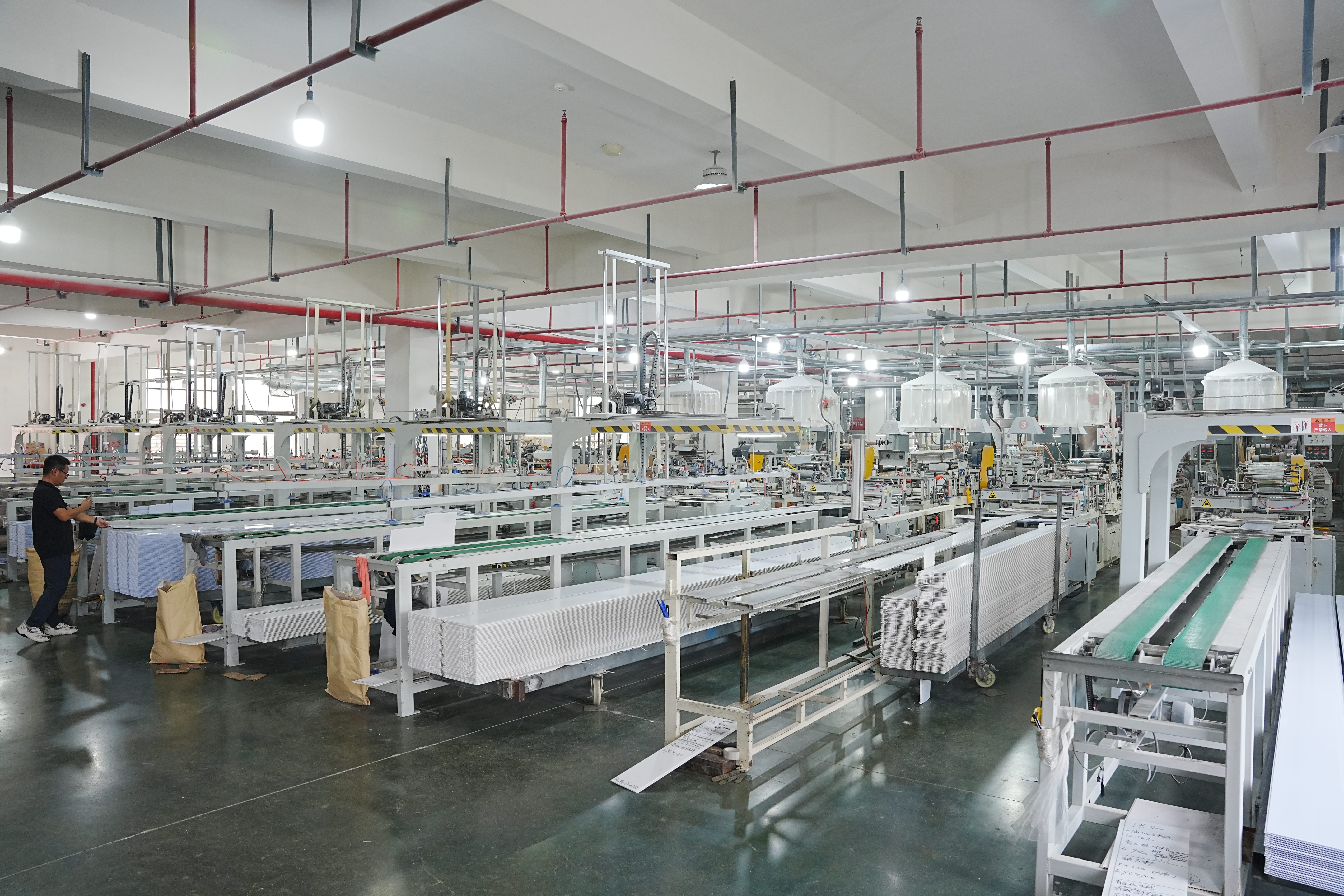
Hisea's stated position is a company founded in 2002, a 20,000 m² manufacturing facility, 300 employees, and a production sequence running from formulation through extrusion or calendering, surface treatment, and cutting and packaging as a closed loop. Monthly output is given as 20 × 40ft high-cube containers, with a 70% export share and main markets across South America, Africa, Southeast Asia and the Middle East. A separate capability summary lists OEM production, custom patterns, custom colours, custom sizes and custom packaging, with a 300-piece MOQ and a 20–30 day lead time.
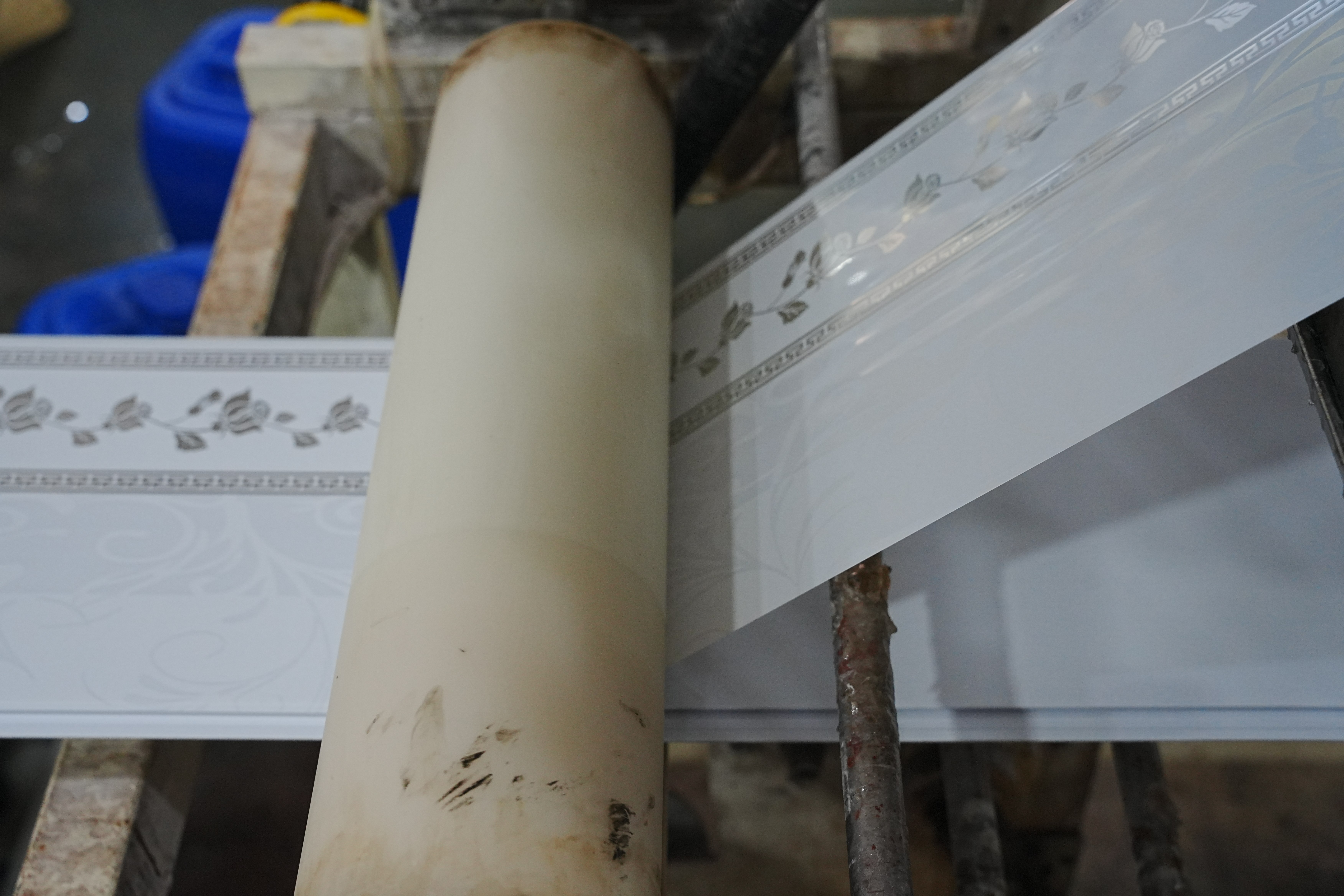
Now convert your requirement into a share of that output. Twenty 40ft high-cube containers a month is roughly one container per working day across a 22-day month. A five-container order therefore represents about a quarter of one month's stated capacity, and a two-container order about 10%. Two questions follow naturally, and neither is hostile: what else is already scheduled in the month you need, and does the monthly figure describe a normal month or a peak month. Both are ordinary production planning, and the answers tell you more about delivery risk than any on-time percentage.
Two further ratios are worth extracting when you compare suppliers. Facility area per employee — about 67 m² per person at 20,000 m² and 300 employees — shows how much space sits behind each worker; it is a comparison input, not a quality score, because automated and labour-intensive plants produce very different numbers. Export share is the second: 70% indicates routine handling of export packing, documentation and loading, but says nothing about which markets absorbed those shipments. Ask for the destination mix rather than accepting the aggregate.
None of these figures is an audit. Footprint, headcount and monthly output are supplier-reported and describe capability, not utilisation, and a monthly output figure is not a booking. What they give you is a denominator — once the claimed monthly output is known, every lead-time promise, MOQ request and expedite request can be expressed as a fraction of it and tested against the production calendar.
Step 2 — Map the QC gates before you discuss defect rates
Hisea describes quality control as three stages rather than one final inspection. Incoming materials are inspected batch by batch so that formulation and process parameters stay consistent. At in-process control points, the parameters monitored are thickness, density, colour difference, surface flatness and texture consistency. Outgoing goods are handled as a batch gate: every batch is inspected before shipment, and loading is arranged only after the batch passes inspection. A separate capability summary states 100% testing.
Each of those parameters maps onto a dispute that appears after delivery, which is why they are worth naming in the purchase order instead of leaving the clause as "QC as per standard".
- Thickness determines whether the panel meets the specified profile and how trims and clips seat at the joint.
- Density affects weight, handling, and how cleanly the panel cuts and fixes on site.
- Colour difference is the classic multi-container problem: panels that match within one container may not match between containers.
- Surface flatness shows up as visible gaps or shadow lines once panels are fixed to battens.
- Texture consistency matters most on fluted, wood-grain and embossed decorative faces, where a run is judged as a whole wall rather than panel by panel.
| QC gate | Control points at Hisea | Record to request |
|---|---|---|
| Incoming materials | Raw materials inspected batch by batch for formulation and process-parameter consistency | Incoming batch inspection log, plus the material batch reference carried onto the finished carton |
| In-process | Thickness, density, colour difference, surface flatness, texture consistency | In-process control sheet showing check frequency and the values recorded |
| Pre-shipment | Every batch inspected before shipment; loading arranged only after the batch passes | Pre-shipment batch inspection report with pass/fail status and the sampling basis |
The productive question is not "what is your defect rate" — a number that is almost impossible to compare across suppliers — but "which gate stops a batch, and who signs the release". A supplier that can name the person, the record and the point at which loading is blocked has a working gate. One that describes quality as a department rather than a step does not.
Step 3 — Match certificate scope to the SKU on your purchase order
Certification is where evaluation most often stops too early, because a certificate number is accepted as an answer when it is actually a scope statement.
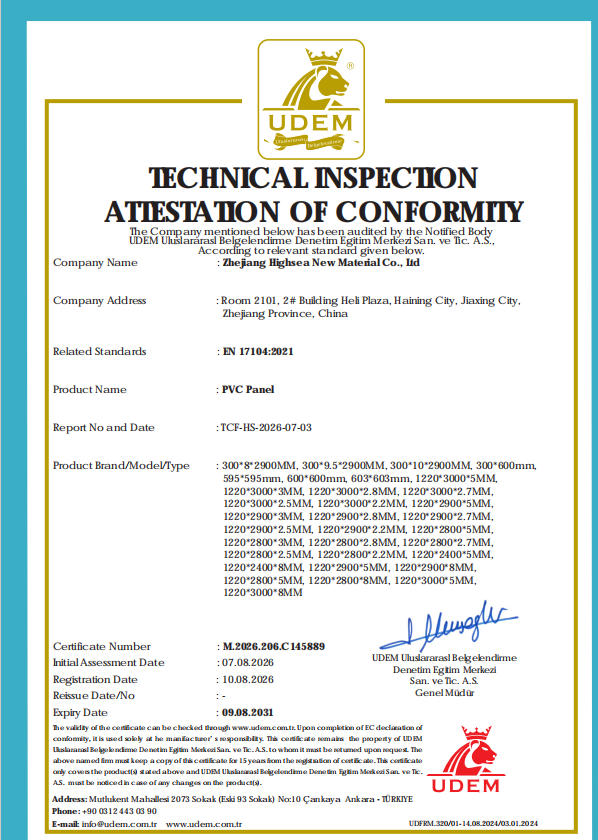
Hisea holds two UDEM technical inspection attestations of conformity to EN 17104:2021. The PVC Panel attestation, number M.2026.206.C145889, was issued on 10 August 2026 and is valid to 9 August 2031, covering a defined list of model types: 300 mm wide profiles at 2900 mm in 8, 9.5 and 10 mm thicknesses; 595×595, 600×600 and 603×603 mm ceiling-format panels; and 1220×3000 mm boards in 2.8, 3, 3.2, 5 and 7.5 mm, plus 1220×2900×3.2 mm. The WPC Panel attestation, number M.2026.06.C1.45891, was issued on 7 August 2026 and is valid to 9 August 2031, covering WPC profiles including 160×24, 160×22, 160×20, 150×10, 150×15, 140×18, 140×13, 150×13, 194×10, 180×20, 200×11 and 200×20 mm, square and rectangular sections at 50×50, 50×10, 50×90 and 50×150 mm, and 1220×3000 mm boards in 2.8, 3 and 5 mm.
The buyer's check is a direct comparison. Write the model or dimension of every SKU on your purchase order beside the certificate's model list. If your order is a custom size agreed for an OEM programme, or a board format outside the listed dimensions, that SKU may fall outside the listed types — not because the certificate is invalid, but because it describes something else. Ask the supplier to confirm in writing which listed type your product corresponds to, or to supply the applicable document.
RoHS and REACH SVHC answer a different question from CE. Hisea states CE and RoHS certification for its products, and the CE attestations are supplied as documents, so the matching step is to request the RoHS test report reference and the declaration of conformity sitting behind the CE attestation, then confirm that the report names the same material and model as your order.
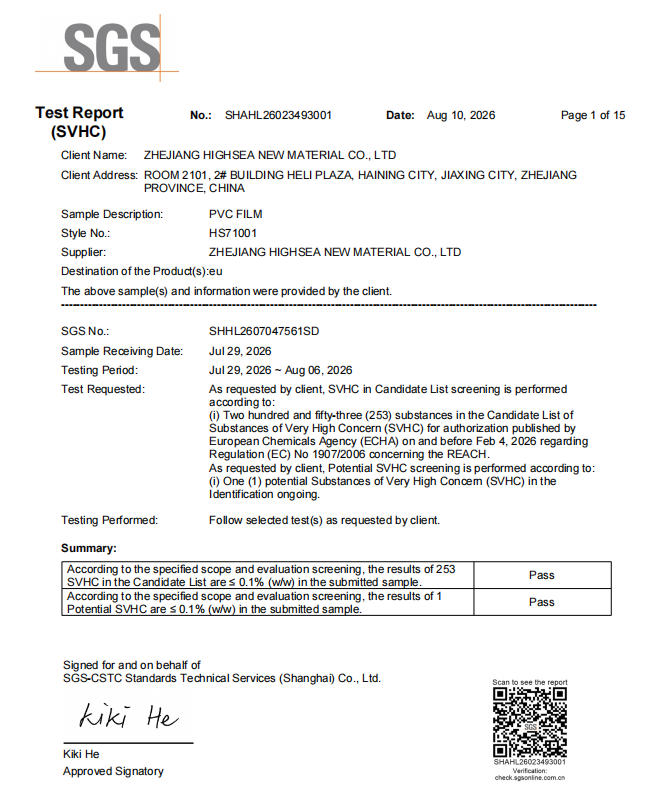
For REACH, the supplied evidence is an SGS test report, number SHAHL26023493001, issued on 10 August 2026, screening 253 substances on the Candidate List plus one potential SVHC against Regulation (EC) No 1907/2006. The reported result is that each screened substance is at or below 0.1% (w/w) in the submitted sample. The scope should be read precisely: the sample was PVC film, style HS71001, supplied by Zhejiang Highsea New Material Co., Ltd. That is a film-level statement. If you buy a film-laminated wall panel, the film is the part the report covers — ask the supplier to link the film style number to the panel SKU so the document chain closes.
| Document | Reference in the Hisea file | What it answers | Scope limit to check |
|---|---|---|---|
| CE attestation, PVC Panel | UDEM M.2026.206.C145889, EN 17104:2021, valid to 09.08.2031 | Conformity of the listed PVC panel model types | Only the listed models and dimensions |
| CE attestation, WPC Panel | UDEM M.2026.06.C1.45891, EN 17104:2021, valid to 09.08.2031 | Conformity of the listed WPC panel profiles and boards | Only the listed profiles and board sizes |
| RoHS | Stated by the company; report reference to be requested | Restricted-substance compliance as claimed | Obtain the report and confirm it names your material |
| REACH SVHC | SGS SHAHL26023493001, 10.08.2026 | 253 Candidate List substances + 1 potential SVHC, each ≤0.1% (w/w) | PVC film style HS71001 only — link to the panel SKU |
| QC records | Three-stage inspection described in the company profile | Batch control at incoming, in-process and pre-shipment | Records are internal; request the batch report format |
Keep the standards layers separate. EN 17104:2021 is the standard cited in the supplied attestations. Third-party compliance guidance separately references EN 13245-2:2008 for unplasticised PVC profiles used in interior and exterior wall and ceiling finishes, and identifies EN 13501-1, ASTM E84 and GB 8624 as reaction-to-fire frameworks used in Europe, North America and China respectively. These address different questions — product conformity versus fire classification — and the applicable one depends on the destination market and the project specification. A CE attestation is not a fire classification, and classes from different frameworks should not be compared without a formal equivalence basis.
Step 4 — Convert capacity and QC into a delivery schedule you can enforce
Delivery assurance is where capacity, QC and paperwork meet, and it is the part of an evaluation most often left as a verbal promise. Hisea's stated production lead time is 20–30 days, and its buyer FAQ cites a typical 20–25 days after deposit for a 40HQ container. The two are compatible — the FAQ figure sits inside the stated range — but they are not interchangeable. Ask which applies to your panel type, colour and quantity, and ask what starts the clock: deposit receipt, colour approval, or material arrival.
MOQ needs the same treatment. Trial orders are described as starting from 300 pieces and can be mixed by colour and size, while a separate procurement-terms summary in the same file lists an MOQ of 200 pieces. The difference is small in absolute terms and material in a first order — and it is exactly the kind of gap a written quotation closes. Do not resolve it by choosing the lower number. Resolve it by having one figure on the order confirmation, together with the colour and size mix it applies to.
Then build the commitment as a sequence rather than a single date:
- Order confirmation — model, dimensions, colour standard, packaging, quantity and MOQ basis.
- Material batch allocation — which raw-material batch will be used, recorded at incoming inspection.
- In-process control — thickness, density, colour difference, flatness and texture checks logged.
- Pre-shipment batch inspection — every batch inspected; loading arranged only after the batch passes.
- Loading and documents — packing list, inspection record and compliance documents matched to the shipped SKU.
Step four is the clause worth writing into the purchase order: loading is conditional on the batch passing pre-shipment inspection. That single sentence converts a quality claim into a delivery control, because a failed batch then costs the supplier a container slot rather than a rework note.
Add one export-documentation question. Commercial market sources list HS 391810 as a primary heading for rigid PVC wall and ceiling coverings and note 391890, 392049, 392190, 392590 and 392690 as possible related headings depending on construction and product form. That is indicative classification, not a customs ruling. Ask which heading appears on the supplier's previous declarations for the product you are buying, and confirm the applicable code with your own broker before modelling landed cost.
Step 5 — Verify customization scope before you design around it
Custom capability is the claim buyers most often take on trust, because it is the hardest to test without placing an order. Hisea's OEM scope is stated as custom pattern development, custom colour matching, custom packaging and custom size customization, with OEM production available for custom production orders. The evaluation task is to bound that scope in writing.
- Patterns — ask how a new pattern is developed and what MOQ applies per pattern; pattern development is a set-up and tooling decision, so it changes the economics of a small first order.
- Colour — colour matching and colour-difference control are connected. The in-process gate checks colour difference, which means an approved master standard has to exist before production, not at loading. Agree the physical standard, the viewing condition for comparison and the acceptable difference, then reference all three in the order.
- Sizes — standard fluted WPC sizes are 160×22, 160×24, 150×15, 160×16, 160×13, 195×12 and 195×14 mm. A custom size outside the certificate's model list remains a legitimate order, but it will not be described by the listed attestation; plan a separate conformity route if your market requires one.
- Packaging — the cheapest customization to verify. Request a dieline or a photograph of a finished export carton before the production run.
Where the panels are going shapes the questions as well. Hisea lists interior feature walls, TV backgrounds, living rooms and bedrooms, hotel lobbies and corridors, offices and meeting rooms, restaurants, retail stores and showrooms, and ceilings as WPC wall panel applications. Panels are fixed to battens or directly to a flat, dry substrate using clips, screws or adhesive, with matching corner and edge trims; cutting uses standard woodworking tools and no on-site painting or finishing is required. For a hotel decoration wall panel programme, the evaluation question that follows is whether trims, clips and colour-matched batches for every floor arrive together — because installation usually fails at the joints, not in the middle of a panel.
One container-level order as a worked example
Hisea's case records include a personalized customization order shipped as a single 40ft high-cube container to buyers in the Philippines, Poland, Palestine and Portugal, for resale and for personal interior and exterior decoration. The recorded outcome is correct sizing, an installation described as satisfactory, no reported colour difference, and repeat orders placed afterwards.
Read that record for what it demonstrates rather than what it implies. It shows a container-level custom order moving through the same steps described above — size customization, colour control and pre-shipment inspection — and it shows a genuinely multi-market destination mix, consistent with the stated 70% export share. It does not show an independent inspection, a measured defect rate, or performance against a contractual delivery date; those would require the buyer's own records. A supplier case record is useful as a pattern of what was checked, not as a substitute for checking.
What this evidence does not prove
- Footprint, headcount, monthly output and export share are supplier-reported. They are capability statements, not audited utilisation.
- The two CE attestations cover the listed model types only. A custom or unlisted size sits outside their stated scope.
- The SGS SVHC report covers PVC film style HS71001, not every panel, film or UV coated surface in the range.
- RoHS is stated as a certification; the report reference and the declaration behind the CE attestation still need to be supplied and matched to your order.
- No reaction-to-fire classification appears in the supplied documents. If your market or project requires EN 13501-1, ASTM E84 or GB 8624 evidence, request it separately — a conformity attestation is not a fire class.
- Case records describe outcomes as recorded by the supplier. They are not third-party inspections.
A line that stays open after two requests is not a dead end; it is information. Record it, price it, and decide whether the residual risk is acceptable at the order size you are placing.
FAQ: evaluating a wall panel supplier
Which compliance documents should I request before the first wall panel order?
Request a matched set rather than a folder. For a PVC or WPC panel order, ask for the conformity attestation with its number, issuing body, standard and edition, expiry date and model list; the declaration of conformity behind any CE claim; the RoHS report reference; and the REACH SVHC report with the exact material sampled. In the Hisea file that means UDEM attestation M.2026.206.C145889 for listed PVC panel types or M.2026.06.C1.45891 for listed WPC panel types, both to EN 17104:2021 and valid to 9 August 2031, plus SGS report SHAHL26023493001 for SVHC screening of PVC film style HS71001. The document that matters is the one whose scope names your product.
Does CE certification cover fire performance for wall panels?
Not by itself. The supplied Hisea attestations are technical inspection attestations of conformity to EN 17104:2021 for listed PVC and WPC panel types — product conformity documents. Reaction-to-fire performance is a separate question, and commercial compliance guidance associates EN 13501-1 with Europe and the UK, ASTM E84 with the USA and Canada and GB 8624 with China, with the applicable requirement set by the destination market and project specification. If your project needs a fire classification, request the product-specific test report, confirm the current standard edition and check the laboratory's accreditation for that method.
Chinese OEM PVC wall panel manufacturers for custom sizes
Check four things: the standard size range, the custom-size process, whether the custom size falls inside any existing certificate scope, and the MOQ that applies to that size. Hisea's standard fluted WPC sizes run 160×22, 160×24, 150×15, 160×16, 160×13, 195×12 and 195×14 mm, and OEM customization covers patterns, colours, sizes and packaging for custom production orders. Its CE attestations list specific model types — including 300 mm wide PVC profiles, 595–603 mm ceiling-format panels and 1220×3000 mm boards — so a size outside those lists should be confirmed in writing as outside the listed scope rather than assumed to be covered. Lock the MOQ per size and per colour in the quotation, because the file shows 300 pieces for trial orders and 200 pieces in a procurement-terms summary.
How do I verify a supplier's claimed monthly capacity?
Put it in units you can compare. Hisea states 20 × 40ft high-cube containers per month from a 20,000 m² facility with 300 employees — roughly one container per working day across a 22-day month. A five-container order is then about a quarter of one month's stated output, and a two-container order about 10%. Ask what else is scheduled in your production window, whether the figure describes a normal or peak month, and where the 70% export share is shipped. Capacity statements are supplier-reported; the arithmetic tells you whether your order is large or small relative to the plant, which is what determines whether your lead time is realistic.
What MOQ and lead time should I expect, and what has to be in writing?
For Hisea, trial orders are described as starting from 300 pieces, mixable by colour and size, with a 20–30 day production lead time; the buyer FAQ cites a typical 20–25 days after deposit for a 40HQ container. A separate procurement-terms summary lists an MOQ of 200 pieces. Resolve the difference before ordering: one MOQ figure, one lead-time basis, and a stated trigger for when the clock starts. Also confirm that the batch must pass pre-shipment inspection before loading — Hisea's process says loading is arranged only after the batch passes, and that condition belongs in the purchase order rather than in a brochure.
What should a sample tell me before I commit to a container?
Use the sample to test the parameters the supplier says it controls in-process: thickness against the specified profile, density and weight in hand, colour against your approved standard, flatness when the panel is laid on a straight edge, and texture consistency across the face of a fluted or wood-grain panel. Check trims, clips and edge profiles at the same time. Hisea states that panels fix to battens or a flat, dry substrate with clips, screws or adhesive and matching corner and edge trims, that cutting uses standard woodworking tools, and that no on-site painting is needed — confirm those fixing components are quoted with the panels.
Where can I get the full product file for evaluation?
Hisea publishes a catalogue covering its bamboo charcoal wall panel range, downloadable from the link at the end of this article, which can be read alongside the certificate and report references above. For a specific order, the useful next step is to send the SKU list — model, dimensions, colour standard, quantity and destination market — and ask for the matching documents, MOQ per pattern and lead-time basis in a single reply.
Conclusion: the evaluation ends in a document set, not a score
A wall panel supplier audit does not produce a rating. It produces a file: a capacity figure expressed as a share of your order, three QC gates with named parameters and named records, certificate numbers matched line by line to the SKUs on the purchase order, an SVHC report whose sampled material is identified, and a purchase-order clause that blocks loading until the batch passes inspection. Where a line in that file cannot be completed, the gap itself is the finding — and it should change the order size, the payment terms or the inspection arrangement rather than being absorbed silently.
Used this way, the Hisea facts in this guide function as a template for what written evidence looks like: 20,000 m² and 300 employees against 20 × 40ft containers a month; incoming, in-process and pre-shipment gates controlling thickness, density, colour, flatness and texture; two EN 17104:2021 attestations with explicit model lists and a 2031 expiry; and an SGS SVHC report scoped to one PVC film style. Each is checkable, each has a boundary, and the boundary is the part that protects the buyer.
Next step for an active evaluation
Send the SKU list — model, dimensions, colour standard, quantity and destination market — and ask for the matching certificate and report references, the MOQ per pattern and the lead-time basis in one reply. Contact: Tommy, +86 135-8645-8141, Tommy@zjhisea.com. Address: Room 2101, 2# Building Heli Plaza, No.365 Qianjiang Road, Haining City, Zhejiang Province, China 314400.
Company reference: Zhejiang Highsea New Material Co., Ltd. · Product catalogue: download the bamboo charcoal wall panel catalogue (PDF).
Have Questions or Need More Details?
Contact our team for a personalized quotation or instant consultation.
Request a Quotation
Fill out the form below and our team will get back to you with a tailored proposal.
WhatsApp Direct Chat
Prefer to chat in real-time? Message us on WhatsApp for instant assistance & quick answers.
- Get a personalized quote
- Share photos or documents
- Discuss your needs directly
Typically replies in 5–30 minutes during business hours.