
Ranked: Best Wall Panel Types for Humid and High-Moisture Interiors in 2026
Ranked by moisture performance for humid and high-moisture interiors in 2026, the order is: 1 — PVC wall panel, 2 — WPC wall panel, 3 — UV coated board. PVC takes first place because the extruded polyvinyl chloride body forms a continuous non-porous surface that does not absorb water or hold odours, which is the property that decides whether a bathroom, clinic or food preparation room wall stays cleanable through years of washing. WPC takes second because its polymer content surrounds the wood fibre and limits water uptake, so the board resists swelling, rot and insect attack while also being usable on covered exterior walls. UV coated board takes third place for full wet zones: its strength is a dense, sealed UV-cured film that resists water rings, grease spots and light scratches, which makes it a strong choice for vanities, cabinet fronts and feature walls inside humid rooms rather than for a continuous washable wall lining.
This ranking is written for specifiers, contractors and importers who are in the research and evaluation stage — the point where the room requirements are already fixed but the material decision is still open. It compares three panel families from the Hisea portfolio against the conditions that decide long-term performance in wet rooms, and it states where each family stops being the right answer, because a ranked shortlist that never rules anything out is not a specification tool.
Hisea-Decorative Film & Decorative Panels is the decorative panel brand of Zhejiang Highsea New Material Co., Ltd., a Chinese manufacturer founded in 2002 that produces WPC wall panels, PVC wall panels, UV boards, outdoor wall panels and decking from a 20,000 m² factory with about 300 employees, and exports roughly 70% of its output.
How This Ranking Was Scored
Moisture performance is not a single number, so the three families were scored on six criteria that can be checked on a datasheet, a sample and a certificate rather than on a marketing claim:
- Water uptake of the panel body. Whether the material absorbs water, or limits and resists it.
- Surface behaviour under service. How the face behaves against splashes, grease, staining and routine wiping.
- Joint and edge detail. Whether the system can be trimmed, closed and re-sealed at corners, cut edges and service penetrations.
- Format and fabrication route. Plank, sheet or board — because format decides joint count, trim count and cutting waste.
- Installation method. Whether the wall can be finished dry, without wet trades and curing time.
- Documentation for the destination market. CE and RoHS coverage, EN 17104:2021 declarations where required, and fire-classification reports issued for the exact product.
Problem Definition: Where Humid Interiors Actually Fail
Moisture damage in a wall lining rarely begins in the middle of a panel. It begins at the body, at the face and at the joint.
The body is where water uptake decides the outcome. A core that takes in water will swell, lose dimensional stability and, in a warm humid room, create the conditions for rot and insect attack. A body that does not absorb water keeps its thickness and its flat face, which is what allows tiles, trims and fixtures to stay aligned years after handover.
The face decides how the room is cleaned. In commercial kitchens, clinics and public washrooms, cleaning is a daily, repeated action rather than an occasional one. Where the decorative face is thin or absorbent, splashes and grease sit in the surface instead of on it, and cleaning time per square metre rises for the life of the building.
The joint is where most callbacks come from. Corners, cut edges, skirting lines and pipe penetrations are the routes by which water reaches a substrate, and a panel family that lacks matching trims forces installers to improvise sealant lines that fail first.
For wall decoration projects in this category, the stated requirements are consistent: waterproof performance, termite resistance, low formaldehyde emission and easy cleaning. A panel that satisfies only two of those four is a compromise that usually shows up in maintenance rather than at handover.
Industry Background: Why Moisture Performance Is Now a Specification Line
Decorative wall panels have moved from a finish item to a specification line because renovation work in humid climates is now a large, repeatable category. Commercial market research published in 2026 values the global PVC panels market at USD 14.8 billion in 2025, with wall panels holding the largest product-type share at 42.5%. The same body of research projects the global wood plastic composites market growing from an estimated USD 8.9 billion in 2025 to USD 21.5 billion by 2033, a CAGR of 11.7%.
Those figures come from commercial research houses and are useful for direction, not for a project budget. What they confirm is structural: both rigid PVC and wood-plastic composite wall systems are being bought at volume, which means the differences between them now matter to buyers who cannot inspect every batch in person.
Application coverage follows the same pattern. Hisea panel supply for interior and exterior wall decoration is used in projects across Indonesia, Japan, Saudi Arabia and Poland — four markets with very different humidity profiles, from tropical coastal air to dry continental winters, and four different compliance files. That is why the ranking below is written around room condition and market documentation instead of around a generic “waterproof” label.
The standards landscape sets the frame. EN 17104:2021 is the harmonised European product standard covering rigid thermoplastic protective wallcovering panels for internal use in buildings, which is the product category a PVC wall panel falls into. EN 13245-2:2008 specifies health and safety requirements for unplasticized PVC-U profiles and cellular PVC-UE profiles used for interior and exterior wall and ceiling finishes. Fire classification is a separate question again, and it is market-specific: EN 13501-1 is used in Europe and the UK, ASTM E84 in the USA and Canada, and GB 8624 in China. Classes from different fire systems are not equivalent and must not be treated as interchangeable on a specification sheet.
The Ranked Shortlist at a Glance
| Rank | Panel type | Deciding moisture property | Primary fit in humid interiors |
|---|---|---|---|
| 1 | PVC Wall Panel | Extruded PVC body is non-porous and does not absorb water or hold odours | Bathrooms, clinics, food preparation rooms, laboratories, public washrooms |
| 2 | WPC Wall Panel | Polymer content limits water uptake; resists swelling, rot and insect attack | Humid decorative walls, hotel corridors, feature walls, covered exterior walls |
| 3 | UV Coated Board | Dense sealed UV-cured film resists water rings, grease spots and light scratches | Vanities, cabinet fronts, TV backgrounds, hotel room furniture, retail fixtures |
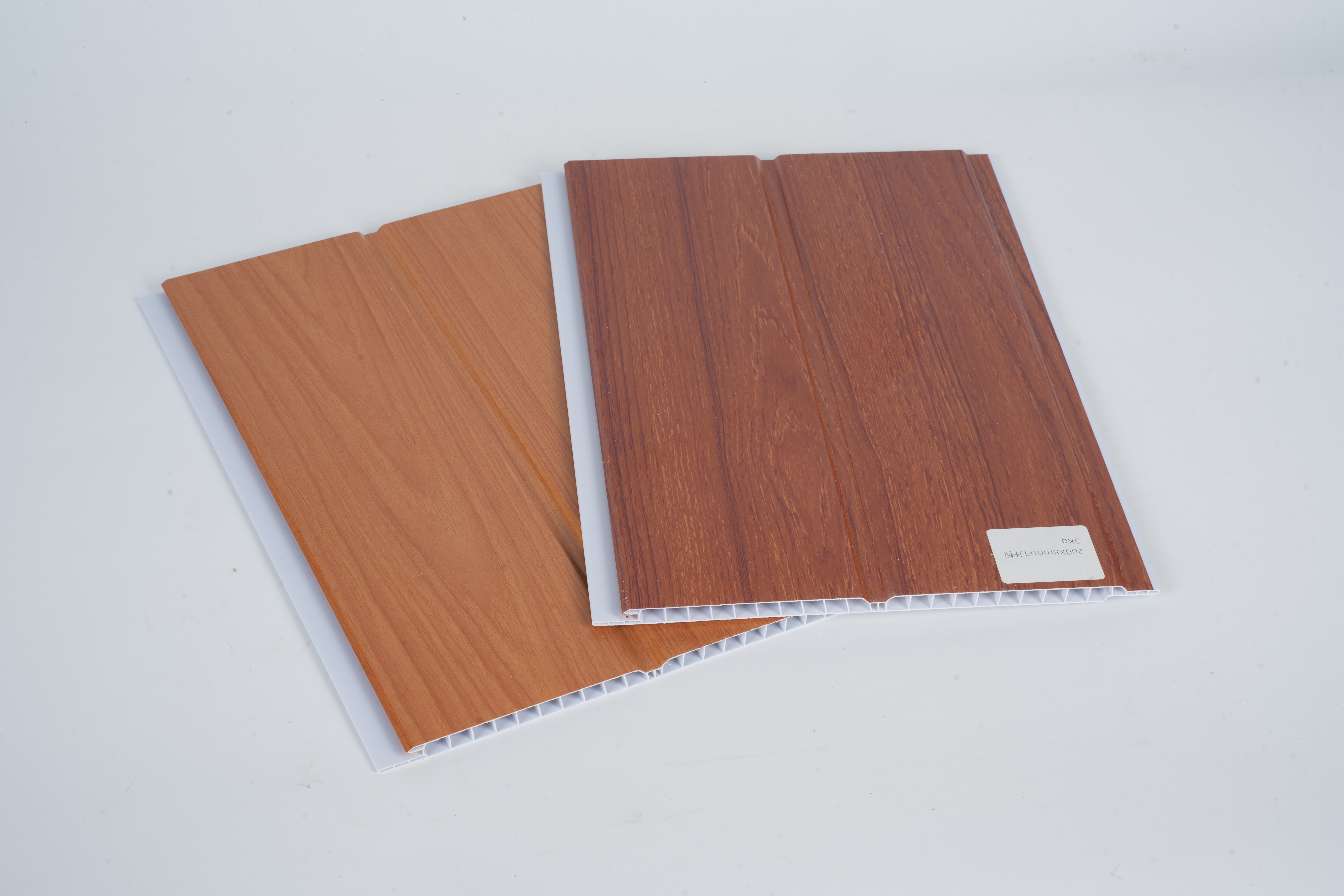
PVC wall panel: an extruded, non-porous sheet body that does not absorb water — the property that places it first for bathrooms, clinics and food preparation rooms.
Rank 1 — PVC Wall Panel: Best Moisture Performance for Wet and Hygiene Zones
Why it ranks first: the panel is extruded from polyvinyl chloride, so the sheet forms a continuous non-porous surface. Water does not enter the body, and odours do not settle into it. That single property removes the failure mode that damages every absorbent wall lining in a wet room.
Material properties behind the ranking
- Non-porous body. A continuous PVC surface does not absorb water or hold odours, which helps keep walls dry in kitchens, bathrooms and other wet service areas.
- Water and stain resistance. Splashes, grease and everyday marks stay on the surface rather than soaking in, so routine cleaning is normally a wipe with a damp cloth instead of hard scrubbing — a direct saving in cleaning hours in busy commercial kitchens and washrooms.
- Decorative range. Wood grain, marble and solid colour prints are supplied across a range of panel widths, so a room can be matched to a joinery or tile scheme using trims and profiles from the same range.
- Light and easy fabrication. Because the sheet is light next to ceramic tile or stone, one installer can carry and align full lengths; panels trim with a utility knife or fine-tooth saw and join with matching edge trims.
- Hygiene-sensitive application. The panel is widely chosen for clinics, food preparation rooms, laboratories and public washrooms, where a smooth washable wall surface has to meet routine cleaning demands.
- Formats in the HS-PVC WALL PANEL range: 300×8 mm and 300×8.5 mm.
Where PVC is the right answer — and where it is not
PVC wall panel is the correct first choice wherever the dominant requirement is a washable, continuous lining that resists water absorption: shower surrounds, clinic treatment rooms, food preparation areas, laboratory walls and public washrooms. It is a weaker fit where the design calls for deep fluted relief, slatted shadow lines or a timber-like exterior wall, because those are profile-led requirements rather than hygiene-led ones — and that is exactly the ground on which WPC takes second place.
Rank 2 — WPC Wall Panel: Moisture and Rot Resistance With Profile Depth
Why it ranks second: the board is blended from wood fibre and thermoplastic resin. The polymer content surrounds the wood fibre and limits water uptake, so the panel resists swelling, rot and insect attack while keeping the warm grain of timber — and it can be used indoors and on covered exterior walls with the same material family.
Material properties behind the ranking
- Wood plastic composite build. Wood fibre blended with thermoplastic resin pairs the natural grain of timber with the dimensional stability of polymer, so the board keeps a flat and true surface in humid or dry climates where solid timber would tend to warp.
- Moisture and rot resistance. The polymer content limits water uptake and resists swelling, rot and insect attack, which makes WPC a practical wall finish for bathrooms, laundry areas and covered outdoor walls.
- Fluted and slatted profiles. Fluted, slatted, louver and flat profiles are offered with wood grain or solid colour faces, so one panel family lets a wall change character by swapping groove depth and coating rather than changing the base material.
- Dry fix installation. Panels are cut, drilled and fixed with ordinary woodworking tools and hidden clips, so a room or facade can be refinished without wet trades, curing time or heavy demolition work — which shortens site programmes.
- Indoor and outdoor use. The same material covers feature walls, TV backgrounds, hotel corridors, retail fronts and balcony or patio cladding, reducing the number of different wall products a project has to stock and maintain.
- Formats in the HS-WPC WALL PANEL range: 160×22 mm, 160×24 mm, 150×10 mm, 150×15 mm and 195×12 mm.
Where WPC is the right answer — and where it is not
WPC is the better fit whenever relief, warmth and continuity between interior feature walls and covered exterior walls matter more than maximum wipe-down performance. It is second rather than first for the strictest wet-zone duty because the body contains wood fibre: on a cut edge or an open joint, the edge detail has to be closed with the matching trim, and the closure detail should be confirmed in writing with the supplier before fabrication. Where a project demands zero wood-fibre content and the simplest possible cleaning routine, PVC remains the first choice.
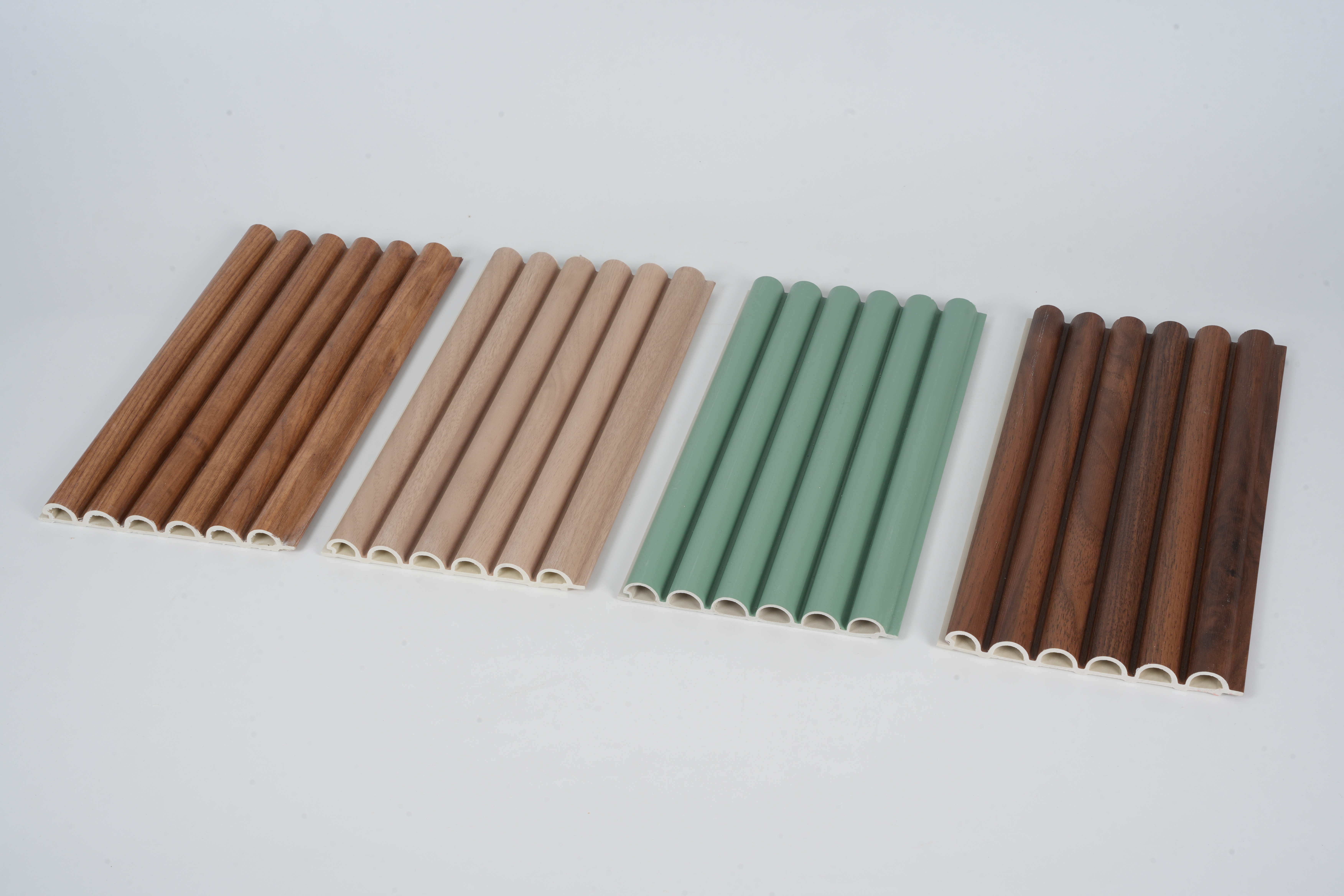
WPC wall panel: wood fibre bonded in thermoplastic resin, offered in fluted, slatted, louver and flat profiles for humid interior walls and covered exterior walls.
Rank 3 — UV Coated Board: Dense Sealed Surface for Components and Feature Panels
Why it ranks third for wet zones: the board carries a UV-cured coating that hardens under ultraviolet light into a dense sealed film over the base sheet. That film is excellent at resisting water rings, grease and light scratches on horizontal and vertical surfaces — but the product is built as a large-format board for cabinetry, furniture and feature surfaces, so in a wet room it is a component-level answer rather than a full wall lining.
Material properties behind the ranking
- UV cured surface layer. The coating hardens under ultraviolet light into a dense sealed film over the base sheet, so the decorative face keeps its sheen through daily contact, wiping and handling.
- Surface protection. The cured film takes common household marks such as water rings, grease spots and light scratches, so printed patterns and colours stay readable on cabinet fronts, wall boards and furniture faces through long service.
- Marble and stone looks. Marble, stone and solid colour designs are offered with gloss or matte faces, reproducing the character of natural slab at a fraction of the weight — stone effects without slab handling problems.
- Panel shop fabrication. The sheet cuts, drills and edge bands with standard panel tooling, so fabricators can turn it into cabinet doors, wardrobe fronts and wall cladding without changing their existing production line or adding new machines.
- Interior decoration use. It is used for kitchen and bathroom cabinets, TV background walls, hotel room furniture and retail fixtures — surfaces that face moisture and frequent wiping as part of daily use.
- Formats in the HS-UV BOARD range: 1220×2440×3 mm and 1220×2440×2.5 mm.
Where UV coated board is the right answer — and where it is not
UV coated board is the strongest of the three on sealed surface protection and the weakest on continuous wet-wall continuity. It wins on vanities, cabinet fronts, wardrobe faces, hotel room furniture, TV backgrounds and retail fixtures inside humid rooms, where the surface has to survive wiping and keep a stone or gloss appearance. It is not the right first choice for a shower wall or a wash-down food room, because a 1220×2440 mm board has to be laid out with a designed joint and edge-band system, whereas a PVC or WPC plank system is built around trims from the same range.
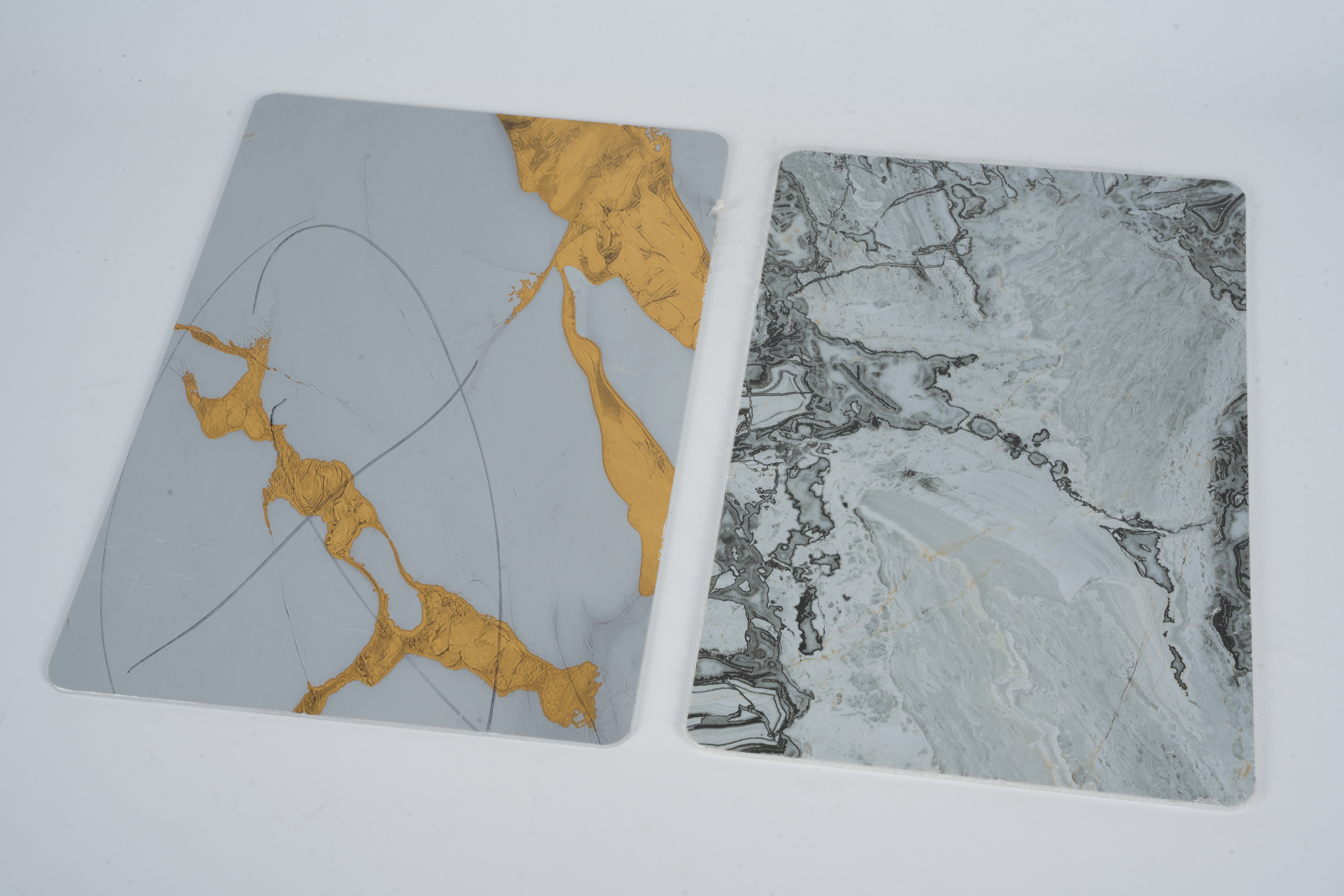
UV coated board: a UV-cured film forms a dense sealed face for cabinet fronts, vanity units and feature walls where wiping and humidity are part of daily use.
Adjacent family, not ranked here: bamboo charcoal board is also produced in 1220×2440 mm at 5 mm and 8 mm. It is listed as a separate family rather than in this shortlist because a moisture claim should be tied to that product's own datasheet instead of being inferred from another panel type. Request the sheet-level data before specifying it for a wet room.
Step-by-Step: Specifying a Wall Panel System for a Humid Interior
The seven steps below follow the order in which an error becomes expensive. Getting step 1 wrong makes every later decision provisional; skipping step 4 turns a material choice into a compliance problem at handover.
Step 1 — Define the exposure class of each wall
Separate the room into zones: direct splash (shower surrounds, wash troughs, hose-down walls), frequent condensation with occasional splashing (bathrooms, laundry areas, commercial kitchens), and decorative humidity (hotel rooms, corridors, retail interiors in coastal air). The zone, not the room name, decides which of the three families is specified.
Step 2 — Choose the family against the dominant requirement
Hygiene-led wipe-down duty points to PVC; profile depth, warmth and covered exterior continuity point to WPC; sealed component surfaces such as vanities, cabinet fronts and feature panels point to UV coated board.
Step 3 — Lock the format before pricing
Format determines joint layout, trim count and cutting waste. PVC plank systems run at 300×8 mm and 300×8.5 mm; WPC profiles run at 160×22 mm, 160×24 mm, 150×10 mm, 150×15 mm and 195×12 mm; UV board is supplied as a 1220×2440 mm sheet at 3 mm or 2.5 mm. A 3 mm sheet and a 8 mm plank solve the same wall in very different ways, and the cost comparison only becomes valid once the format is fixed.
Step 4 — Build the compliance file for the destination market
Hisea states that its products have obtained CE and RoHS certification, meeting the market-access requirements for electrical safety and restriction of hazardous substances in the relevant markets. Beyond that baseline, request documents that match the exact product: an EN 17104:2021 declaration where the project requires the harmonised European standard for rigid thermoplastic protective wallcovering panels for internal use; the EN 13245-2:2008 reference where PVC-U or PVC-UE profiles are specified for interior or exterior wall and ceiling finishes; and a reaction-to-fire report issued for the exact panel, thickness, construction and finish. Fire reports should cite a current standard edition and a laboratory whose accredited scope covers the test method — a report for a different thickness or surface finish does not transfer.
Step 5 — Confirm the fixing method and the substrate
PVC panels are fixed on battens or directly onto a flat, dry substrate using clips, screws or adhesive, with matching corner and edge trims to finish the joints. WPC panels are cut, drilled and fixed with ordinary woodworking tools and hidden clips. Neither system requires supporting equipment, both are static installations that consume no power, and both avoid wet trades — which means the wall can be closed without waiting for adhesive or render to cure.
Step 6 — Approve a sample and check batch consistency
Samples should be checked for thickness, colour, surface flatness and texture, and compared against the approved reference under the lighting of the actual room. Colour difference is the failure that shows up first on a finished wall, and it is far cheaper to detect on a sample than on a delivered container.
Step 7 — Confirm production terms, quality control and delivery
Trial orders normally start from 300 pieces and can be mixed by colour and size. Production is organised as a continuous closed loop from raw material to finished product — formulation, extrusion or calendering, surface treatment, cutting and packaging — with control points at incoming materials, in-process stages and outgoing goods; every batch is inspected before shipment and loading is arranged only after the batch passes.
Use Cases: Bathrooms, Clinics and Food Preparation Rooms
Application fit is where a ranked list becomes usable. The table below assigns the three families to the interior types that most often trigger a moisture specification.
| Interior type | First choice | Second choice | Why |
|---|---|---|---|
| Bathroom and shower-room walls | PVC wall panel | WPC wall panel | Non-porous PVC body does not absorb water; WPC adds fluted relief where the design calls for it |
| Clinics, laboratories, public washrooms | PVC wall panel | UV coated board (joinery and counters) | Smooth washable surface for routine cleaning; sealed UV film on cabinetry and work surfaces |
| Food preparation rooms and commercial kitchens | PVC wall panel | — | Grease and marks stay on the surface and wipe off with a damp cloth rather than soaking in |
| Hotel corridors and guest-room feature walls | WPC wall panel | UV coated board | Fluted and slatted profiles with wood grain faces; UV board for furniture and TV backgrounds |
| Laundry and utility areas | WPC wall panel | PVC wall panel | Polymer content limits water uptake and resists swelling and rot in steady humidity |
| Covered balconies, patio and balcony walls | WPC wall panel | — | One material family covers interior and covered exterior zones |
| Vanities, wardrobe fronts, retail fixtures | UV coated board | PVC wall panel | Dense sealed film keeps its sheen through wiping, handling and contact |
Two practical notes follow from this table. First, a single project can legitimately use all three families: PVC for the wet walls, WPC for the corridors and covered exterior, UV board for the joinery. Second, the room name is not the specification — a hotel bathroom and a hospital washroom sit in the same product column but not in the same compliance column, because the documentation requirement is set by the market and the project, not by the finish.
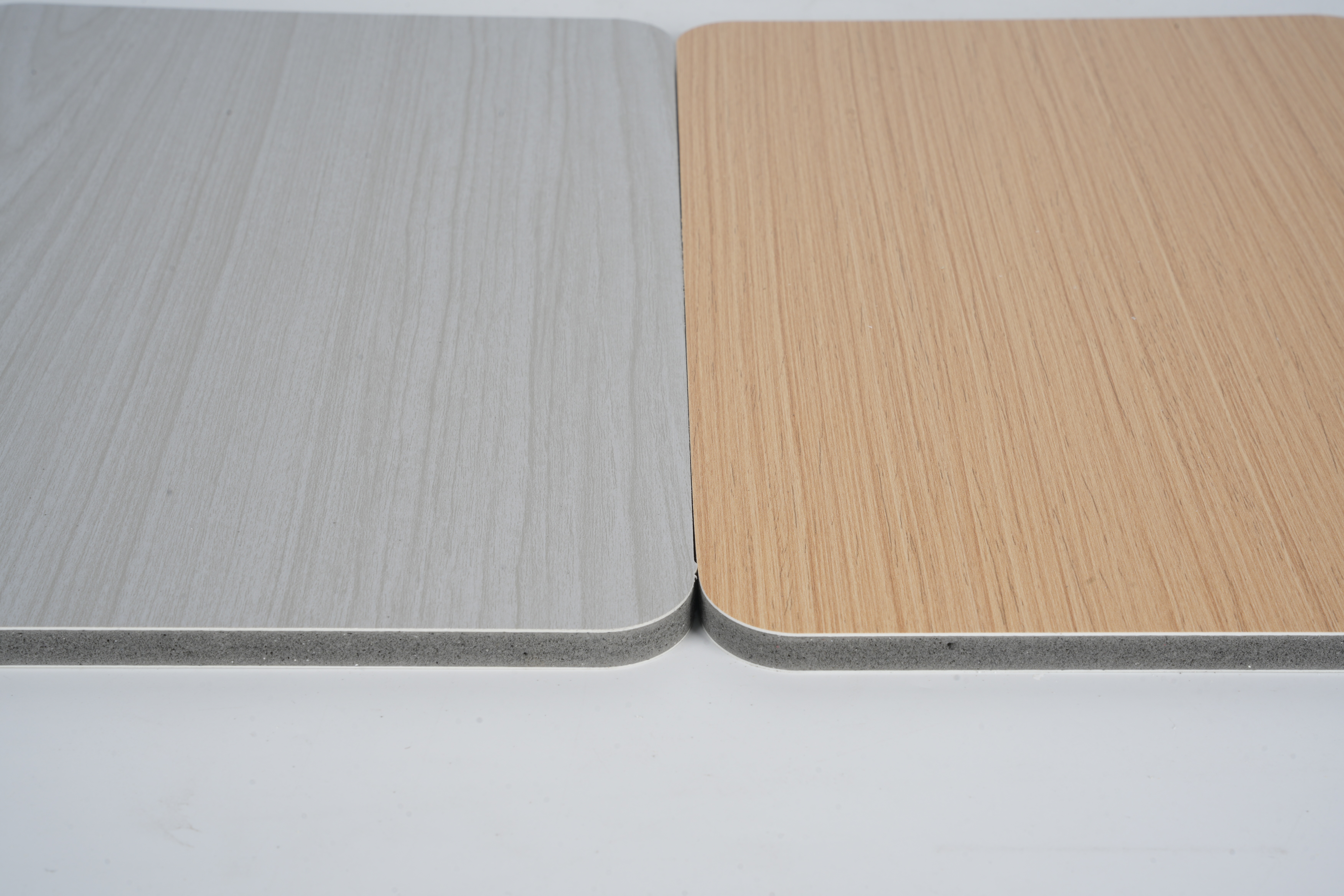
Large-format decorative panel sheets are supplied alongside plank systems; sheet-format products need a designed joint and edge detail in wet rooms.
Comparison Table: PVC vs WPC vs UV Coated Board
| Specification point | PVC Wall Panel | WPC Wall Panel | UV Coated Board |
|---|---|---|---|
| Body construction | Extruded polyvinyl chloride forming a continuous non-porous surface | Wood fibre blended with thermoplastic resin | Base sheet with a UV-cured coating film |
| Moisture behaviour | Does not absorb water and does not hold odours | Polymer surrounds the wood fibre and limits water uptake; resists swelling, rot and insect attack | Cured film takes water rings, grease spots and light scratches on the face |
| Cleaning routine | Wipe with a damp cloth; splashes, grease and marks stay on the surface | Flat, true surface that holds its shape in humid or dry climates | Decorative face keeps its sheen through wiping and handling |
| Face options | Wood grain, marble and solid colour prints across a range of widths | Wood grain or solid colour on fluted, slatted, louver and flat profiles | Marble, stone and solid colour designs, gloss or matte |
| Formats (product data) | 300×8 mm, 300×8.5 mm | 160×22 mm, 160×24 mm, 150×10 mm, 150×15 mm, 195×12 mm | 1220×2440×3 mm, 1220×2440×2.5 mm |
| Fabrication | Trims with a utility knife or fine-tooth saw; joined with matching edge trims | Cut, drilled and fixed with ordinary woodworking tools and hidden clips | Cuts, drills and edge bands with standard panel tooling |
| Typical interior use | Clinics, food preparation rooms, laboratories, public washrooms, kitchens, bathrooms | Feature walls, TV backgrounds, hotel corridors, retail fronts, balcony and patio cladding | Kitchen and bathroom cabinets, TV background walls, hotel room furniture, retail fixtures |
| Wet-zone ranking | 1 | 2 | 3 |
Factory and Batch Evidence Behind the Shortlist
A ranking is only as good as the consistency behind it, and in humid interiors the most common surprise is not the material class but the batch. Hisea runs quality control across three stages: incoming raw materials are inspected batch by batch to ensure consistency of formulation and process parameters; in-process control points monitor thickness, density, colour difference, surface flatness and texture consistency; and every batch is inspected before shipment, with loading arranged only after the batch passes.
Capacity supports container-level procurement: monthly output reaches 20 × 40 ft high-cube containers, which allows multi-container orders to be scheduled with a relatively stable delivery expectation. Trial orders normally start from 300 pieces and can be mixed by colour and size, with OEM customisation available on patterns, packaging, colours and sizes.
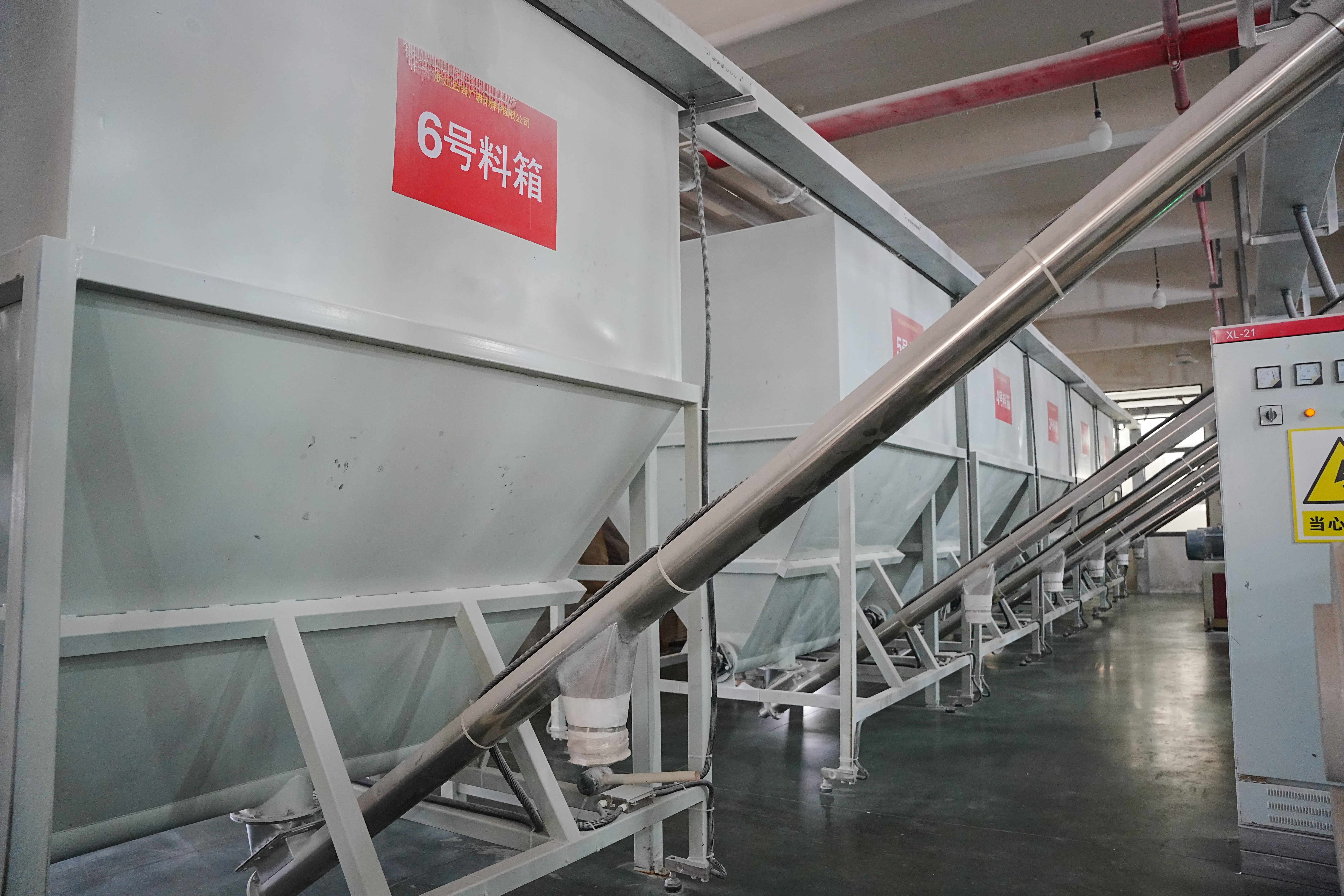
Production is organised as a closed loop from raw material to finished product, with inspection at incoming, in-process and outgoing stages.
A documented case illustrates the indoor-and-outdoor requirement in practice. A customer ordering personalised customisation in a 40 ft high-cube container used the panels for resale and for personal indoor and outdoor decoration; the reported result was an excellent installation effect, correct dimensions, no colour difference and continued repeat orders over a five-year relationship. That outcome depends on the two checks named above — sample approval before production and batch inspection before loading — rather than on the panel family alone.
FAQ
Do wall panels for wet rooms need EN 17104:2021, CE or RoHS documentation?
It depends on the destination market and on the exact product. EN 17104:2021 is the harmonised European product standard for rigid thermoplastic protective wallcovering panels for internal use in buildings, and EN 13245-2:2008 specifies health and safety requirements for unplasticized PVC-U profiles and cellular PVC-UE profiles for interior and exterior wall and ceiling finishes. CE and RoHS address market access for electrical safety and restriction of hazardous substances in the relevant markets, and Zhejiang Highsea New Material Co., Ltd. states that its products have obtained CE and RoHS certification. Because a certificate is only valid for the product, thickness and finish it names, ask for a declaration that matches the panel being ordered, together with any fire-classification report the project's jurisdiction requires.
Which wall panel type fits bathrooms, clinics and food preparation rooms best?
PVC wall panel fits these three interiors best, because the extruded body is non-porous, does not absorb water and does not hold odours, and the panel is widely chosen for clinics, food preparation rooms, laboratories and public washrooms where a smooth washable surface has to meet routine cleaning demands. WPC wall panel is the second choice and works well where fluted or slatted relief is wanted on a humid wall, since its polymer content limits water uptake and resists swelling, rot and insect attack. UV coated board is the third choice for these rooms as a wall lining, but is a strong choice for their cabinetry, vanities and feature panels, where the dense sealed UV-cured film resists water rings, grease spots and light scratches.
Can Chinese waterproof WPC wall panel manufacturers supply bathroom renovation projects?
Yes, and the constraint to check is scheduling rather than capability. Hisea produces WPC wall panels in 160×22 mm, 160×24 mm, 150×10 mm, 150×15 mm and 195×12 mm, with monthly output reaching 20 × 40 ft high-cube containers and roughly 70% of output exported. Bathroom renovation work benefits from the dry-fix method: panels are cut, drilled and fixed with ordinary woodworking tools and hidden clips, so the wall can be refinished without wet trades, curing time or heavy demolition, which shortens the site programme. Trial orders normally start from 300 pieces and can be mixed by colour and size, so a renovation contractor can test several profiles in one order.
What drives cost when comparing PVC, WPC and UV coated board for a humid interior?
Four cost drivers matter more than the headline panel price: the format and thickness specified, the face type, the trims and edge details needed to close the joints, and the installation labour saved by a dry-fix system. As an external reference point, commercial price reporting put average FOB China prices for standard 3 mm PVC marble sheet at USD 3.00–3.60 per m² in 2024 — a useful order-of-magnitude indicator, but one that does not carry MOQ, Incoterm, packaging, freight or the trim package, so it should not be used as a project budget figure. Request a quotation against a fixed specification, with MOQ, Incoterm and trim quantities stated, before comparing suppliers.
Can specifiers get samples, and how long is production?
Samples can be requested for the panel family, format and face being considered, and they should be checked for thickness, colour, surface flatness and texture against the room lighting before production is released. Typical production lead time is 20–30 days; for a 40HQ container, 20–25 days after deposit is the usual planning figure. Every batch is inspected before shipment and loading is arranged only after the batch passes, which is why the sample approval stage is worth the extra few days on a humid-interior project. To start, send the room type, panel family, format and destination market to Tommy at Tommy@zjhisea.com or +86 135-8645-8141.
Conclusion
For humid and high-moisture interiors in 2026, the ranked order is PVC wall panel first, WPC wall panel second and UV coated board third — and the order holds because each step down the list trades moisture certainty for something else. PVC wins on the only property that cannot be compensated for later: a non-porous body that does not absorb water or hold odours, which is why it suits bathrooms, clinics and food preparation rooms. WPC gives up a little of that certainty and returns profile depth, timber warmth and continuity between interior and covered exterior walls. UV coated board gives up full-wall continuity and returns the most protective sealed surface available for vanities, cabinetry and feature panels.
Specifiers who treat this as a three-way contest usually end up with the wrong answer. The correct reading is a zoning decision: one project, three families, each used where its property is the one being tested, supported by a compliance file that names the exact product, thickness and finish for the destination market.
Next Step: Sample, Quotation or Full Catalog
Hisea-Decorative Film & Decorative Panels supplies PVC wall panels, WPC wall panels, UV boards and bamboo charcoal boards from Zhejiang Highsea New Material Co., Ltd. Send the room type, panel family, format and target market, and the response will come back with the matching specification, sample options and a quotation against a fixed configuration.
Contact: Tommy · Tel/WhatsApp +86 135-8645-8141 · Email Tommy@zjhisea.com · Room 2101, 2# Building Heli Plaza, No.365 Qianjiang Road, Haining City, Zhejiang Province, China 314400.
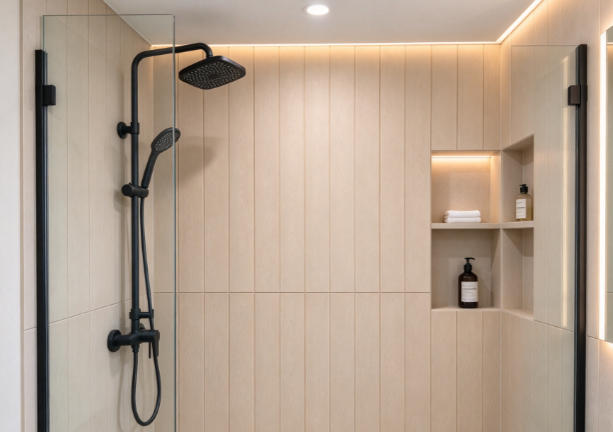
Panels supplied in a 40 ft high-cube container for resale and for personal indoor and outdoor decoration, with customer-reported satisfaction on installation effect and colour consistency.
Have Questions or Need More Details?
Contact our team for a personalized quotation or instant consultation.
Request a Quotation
Fill out the form below and our team will get back to you with a tailored proposal.
WhatsApp Direct Chat
Prefer to chat in real-time? Message us on WhatsApp for instant assistance & quick answers.
- Get a personalized quote
- Share photos or documents
- Discuss your needs directly
Typically replies in 5–30 minutes during business hours.