
WPC vs PVC vs UV Board Wall Panels: 2026 Comparison Guide
for Interior Projects
Interior Wall Panel Selection
Short answer: WPC wall panels are wood-plastic composite profiles supplied in 160×22 mm, 160×24 mm, 150×10 mm, 150×15 mm and 195×12 mm. PVC wall panels are extruded PVC profiles supplied in 300×8 mm and 300×8.5 mm. UV boards are large-format panels supplied in 1220×2440×3 mm and 1220×2440×2.5 mm with gloss or matte faces. The WPC and PVC ranges held by Zhejiang Highsea New Material Co., Ltd. are both covered by an EN 17104:2021 attestation of conformity issued by UDEM; the UV board range is not covered by those two documents and should be documented separately.
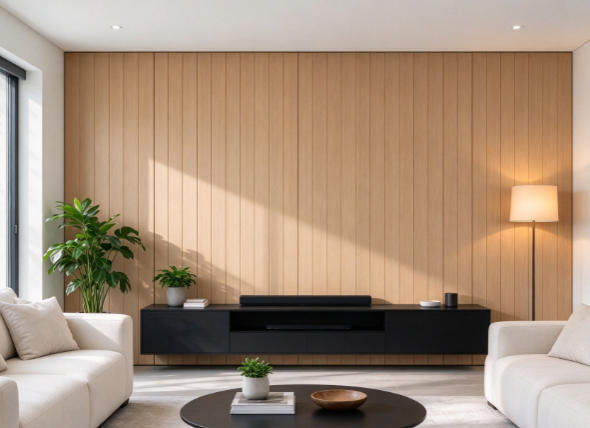
Problem Definition: Why WPC, PVC and UV Boards Are Not Interchangeable
Most interior wall panel enquiries start the same way: a room list, a budget band and a single question — which board should we use? The answer usually goes wrong at the moment three different panel families are priced against each other as if they were the same product with a different finish.
WPC, PVC and UV boards come from three different production routes and three different material systems:
- WPC wall panels are wood plastic composite blends extruded into profile formats, commonly 160 mm or 195 mm wide.
- PVC wall panels are extruded PVC profiles, commonly 300 mm wide.
- UV boards are large-format panels at 1220×2440 mm, supplied at 2.5 mm or 3 mm thickness.
That difference in format changes everything downstream. A 195 mm fluted profile and a 1220 mm board cover a wall at completely different rates, need different corner and edge trims, and produce a different number of visible joints. When both appear on the same enquiry at the same price per square metre, the comparison is already distorted before installation labour, adhesive and trim are added.
Three variables decide the fit, and they are the ones this guide works through: moisture behaviour, fabrication method and surface finish options. A fourth variable — compliance documentation — decides whether the product can enter the destination market at all.
Industry Background: What Changed Heading Into 2026
Two market signals explain why buyers are now comparing these three families more often than they did five years ago.
- The global PVC panels market was valued at USD 14.8 billion in 2025, with wall panels holding the largest product type share at 42.5% (Dataintelo, published 2026-03-15).
- The global wood plastic composites market was estimated at USD 8.9 billion in 2025 and is projected to reach USD 21.5 billion by 2033, a CAGR of 11.7% (Grand View Research, published 2026-09-15).
Read together, the two figures describe a market where PVC remains the volume base while WPC absorbs the growth. For a 2026 interior project, that means the question is rarely “PVC or WPC” in the abstract — it is which of the two, or a UV board, fits a specific wall.
On the standards side, EN 13245-2:2008 specifies the health and safety requirements for unplasticized poly(vinyl chloride) (PVC-U) profiles and cellular PVC-UE profiles used for interior and exterior wall and ceiling finishes, and remains the reference harmonized standard for PVC profile products in the European market.
Procurement guidance published by commercial compliance sources in 2026 keeps repeating the same practical warning: before accepting a supplier conformity claim, verify the exact product, thickness, construction and surface finish named in the report, confirm the report cites the current edition of the standard, and check that the testing laboratory’s accreditation actually covers the test method. Documentation that names a product family but not the specific build is not the same thing as product-specific evidence.
Detailed Solution: How the Three Families Actually Differ
Zhejiang Highsea New Material Co., Ltd. is a manufacturer of decorative films and surfacing materials that also produces integrated building products including SPC and WPC wall panels, UV boards, flooring and WPC decking, and it operates as Hisea-Decorative Film & Decorative Panels for its export markets. The three panel families below are the ones most often quoted together on interior wall projects.
WPC Wall Panel: Wood Plastic Composite Profiles
A WPC wall panel is a wood plastic composite blend extruded into a decorative profile. The format is narrow and ribbed rather than sheet-like, which is why WPC panels are usually specified where a room needs rhythm and shadow lines rather than a continuous flat plane.
Available sizes: 160×22 mm, 160×24 mm, 150×10 mm, 150×15 mm and 195×12 mm. Hisea documentation also lists 160×16 mm, 160×13 mm and 195×14 mm among common standard fluted WPC sizes.
Where it is typically used: interior feature walls, TV backgrounds, living rooms and bedrooms, hotel lobbies and corridors, offices and meeting rooms, restaurants, retail stores and showrooms, and ceilings.
Working conditions: WPC wall panels are specified for indoor and outdoor installation, humid environments and normal ambient temperature, with the stated functional profile covering decorative surfacing, moisture and termite resistance, low formaldehyde and easy cleaning.
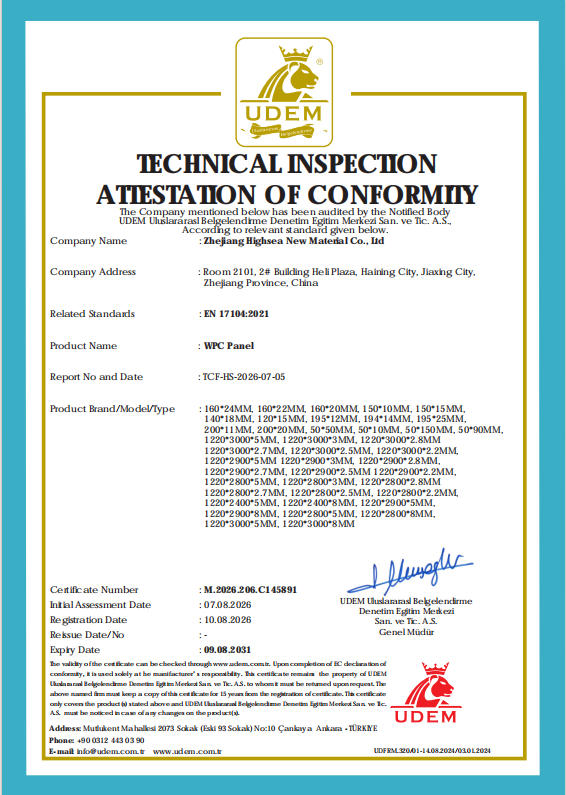
Compliance: the WPC Panel range holds a Technical Inspection Attestation of Conformity issued by UDEM under EN 17104:2021, certificate number M.2026.06.C1.45891, issued 2026-08-07 and valid until 2031-08-09. The attested model list covers profile formats including 160×24 mm, 160×22 mm, 160×20 mm, 150×10 mm, 150×15 mm, 140×18 mm, 140×13 mm, 150×13 mm, 194×10 mm, 180×20 mm, 200×11 mm and 200×20 mm, plus 50 mm accessories and 1220×3000 mm formats.
PVC Wall Panel: Extruded Profiles for Wet and Hygiene-Sensitive Areas
A PVC wall panel is an extruded PVC profile. At 300 mm wide, it covers roughly twice the wall width of a 160 mm WPC profile per fixed run, which shortens installation time on large continuous surfaces.
Available sizes: 300×8 mm and 300×8.5 mm.
How it is installed: PVC panels can be fixed on battens or directly onto a flat, dry substrate using clips, screws or adhesive, with matching corner and edge trims to finish the joints. Cutting is done with standard woodworking tools. Installation is fast and no painting or finishing is required on site.
Where it fits: PVC panels are used as hygienic wall coverings in damp areas, replacing tiles or coatings, and are suitable for decoration company, construction engineering, building materials wholesale and design company applications.
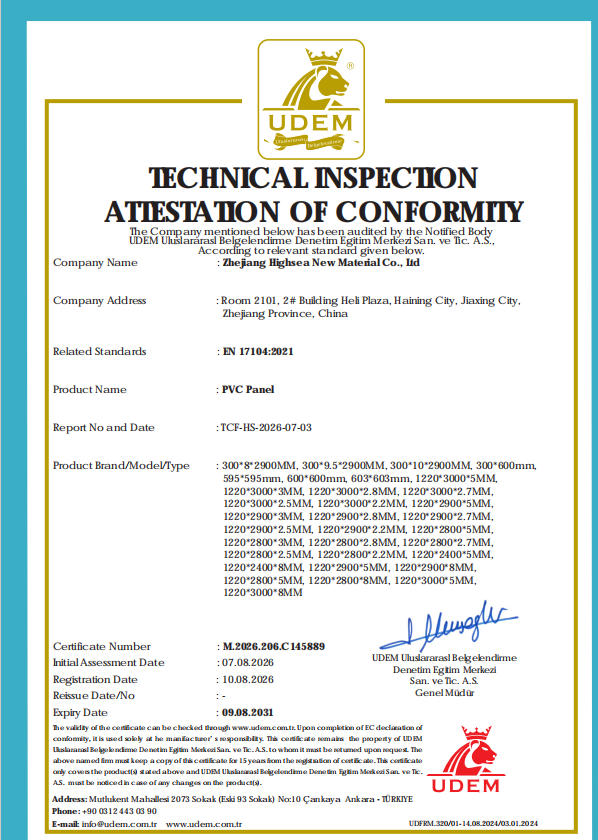
Compliance: the PVC Panel range holds a Technical Inspection Attestation of Conformity issued by UDEM under EN 17104:2021, certificate number M.2026.206.C145889, issued 2026-08-10 and valid until 2031-08-09. The attested range names PVC Panel models including 300×8×2900 mm, 300×9.5×2900 mm, 300×10×2900 mm, 300×600 mm, 595×595 mm, 600×600 mm, 603×603 mm and 1220×3000 mm formats at 2.8 mm to 7.5 mm.
UV Board: Large-Format Panels With Gloss or Matte Faces
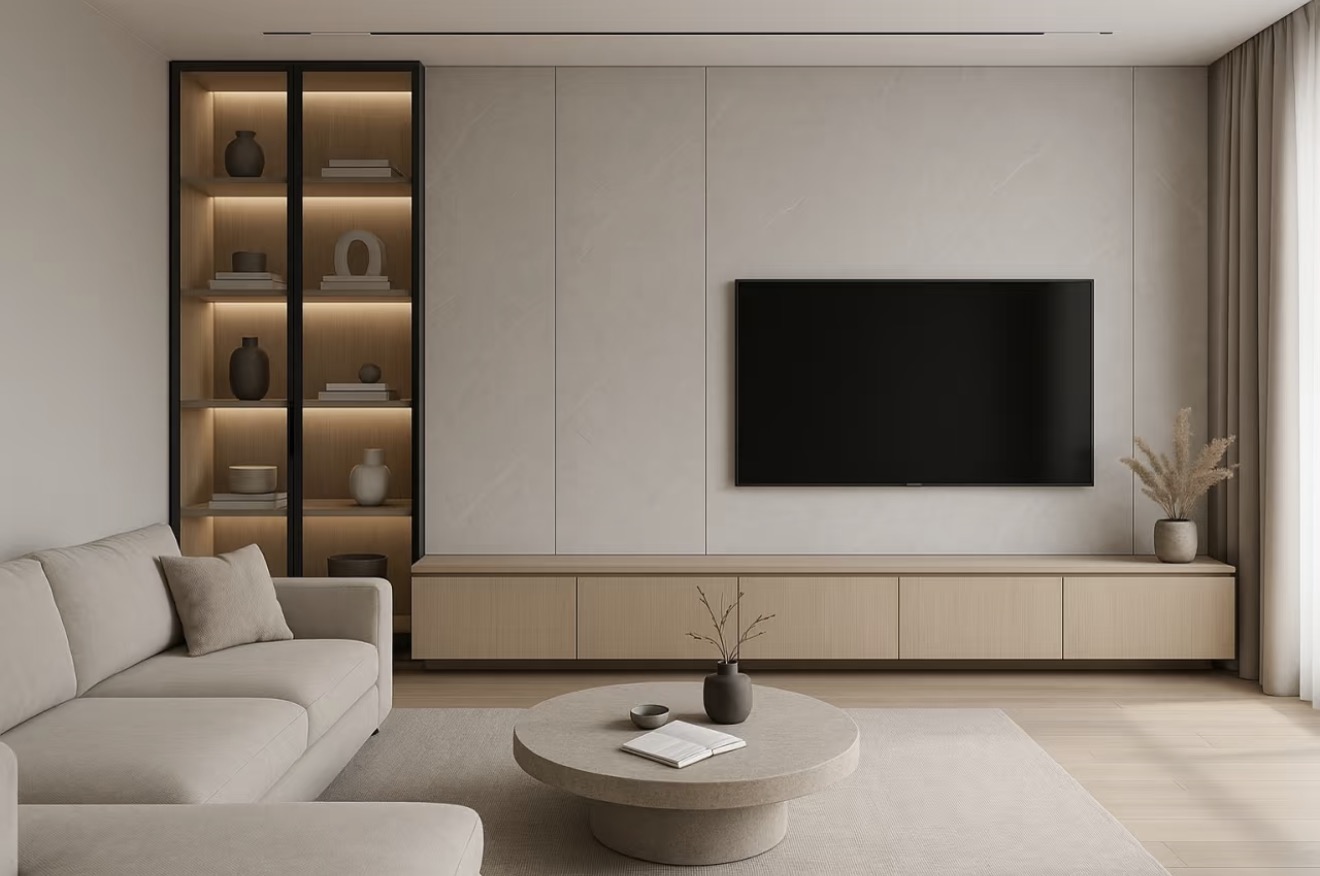
A UV board is a large-format panel rather than an extruded profile. At 1220×2440 mm it covers a broad wall area in a single piece, so a finished surface has far fewer joints than a wall built from 160 mm or 300 mm strips.
Available sizes: 1220×2440×3 mm and 1220×2440×2.5 mm, with gloss or matte faces.
What the format implies: because the panel is supplied as a sheet, the installation logic is closer to panel cutting and cladding than to strip-by-strip profiling. Reducing the visible joint count is the main reason buyers move to this format on long, uninterrupted interior walls.
Finishing choice: gloss and matte faces read differently under interior lighting and under cleaning, so the face option should be decided from a physical sample on site rather than from a screen image.
Compliance: the UV board range is not covered by the two EN 17104:2021 attestations listed above. Buyers specifying UV boards should request documentation specific to that product and to the destination market before confirming an order.
Decision Table: Moisture Behaviour, Fabrication Method and Surface Options
The table below compares the three families only on points supported by the supplied product and compliance records. Where a value is not stated in those records, it is marked as not stated rather than estimated.
| Decision dimension | WPC wall panel | PVC wall panel | UV board |
|---|---|---|---|
| Material composition | Wood plastic composite blend, extruded into decorative profiles | Extruded PVC profile | Large-format panel (sheet build) |
| Available sizes | 160×22 mm, 160×24 mm, 150×10 mm, 150×15 mm, 195×12 mm (standard fluted list also includes 160×16 mm, 160×13 mm, 195×14 mm) | 300×8 mm, 300×8.5 mm | 1220×2440×3 mm, 1220×2440×2.5 mm |
| Moisture behaviour | Specified for indoor and outdoor use, humid environments and normal ambient temperature; stated as moisture- and termite-resistant | Positioned as a hygienic wall covering for damp areas, replacing tiles or coatings | Not stated in the supplied product records |
| Fabrication and fixing method | Profile format; cut and fixed as a profiled strip system with matching trims | Fixed on battens or directly to a flat, dry substrate using clips, screws or adhesive, with matching corner and edge trims; cut with standard woodworking tools; no on-site painting | Sheet format; cut to size and installed with a reduced number of visible joints |
| Surface finish options | Surface treatment applied during the extrusion and finishing loop; specific finish effects are not listed in the supplied size records | Extruded profile surface; specific finish effects are not listed in the supplied size records | Gloss or matte face |
| Compliance document on file | EN 17104:2021 attestation, UDEM M.2026.06.C1.45891, issued 2026-08-07, valid to 2031-08-09 | EN 17104:2021 attestation, UDEM M.2026.206.C145889, issued 2026-08-10, valid to 2031-08-09 | Not covered by the two above; request product-specific documentation |
Step-by-Step Breakdown: Choosing the Right Panel for a Project
The following sequence is the one that avoids re-quoting after the specification is already fixed. It is written for specifiers, importers and wholesale buyers working on interior decoration projects.
Step 1 — Classify each wall by moisture exposure first
Split the room list into wet areas and dry areas before choosing any product. Wet and hygiene-sensitive walls are the ones where PVC panels replace tiles or coatings. Walls that also face outdoors or sit in humid environments fall into the range WPC panels are specified for. Any wall where the panel would sit behind a fixed fixture should be reviewed against the same criteria.
Step 2 — Match panel width to the wall module
Decide whether the wall is meant to read as a series of strips or as one continuous surface. A 160 mm or 195 mm WPC profile creates a ribbed, rhythm-based wall. A 300 mm PVC panel covers the same area in fewer fixed runs. A 1220×2440 mm UV board reduces the joint count further and suits long uninterrupted interior walls. Fixing the format first prevents the classic mistake of pricing a strip system against a sheet system.
Step 3 — Confirm the fixing method against the substrate
PVC panels can go onto battens or straight onto a flat, dry substrate with clips, screws or adhesive, and they need matching corner and edge trims plus standard woodworking tools for cutting, with no on-site painting. Confirm that the substrate is flat and dry before ordering, because an uneven substrate will show through any panel system regardless of material.
Step 4 — Choose the surface from a physical sample
For UV boards, decide between gloss and matte from an actual sample under the project’s own lighting. For WPC and PVC, confirm the finish effect you expect with the supplier, because the supplied size records do not itemise finish options per dimension.
Step 5 — Verify that the certificate covers the exact dimension being ordered
Both the WPC and PVC attestations list specific models and dimensions. Read that list against the dimension on the quotation. Where a dimension is not named in the certificate scope, request a product-specific document before signing.
Step 6 — Validate quality control on the production line, not only in the sample
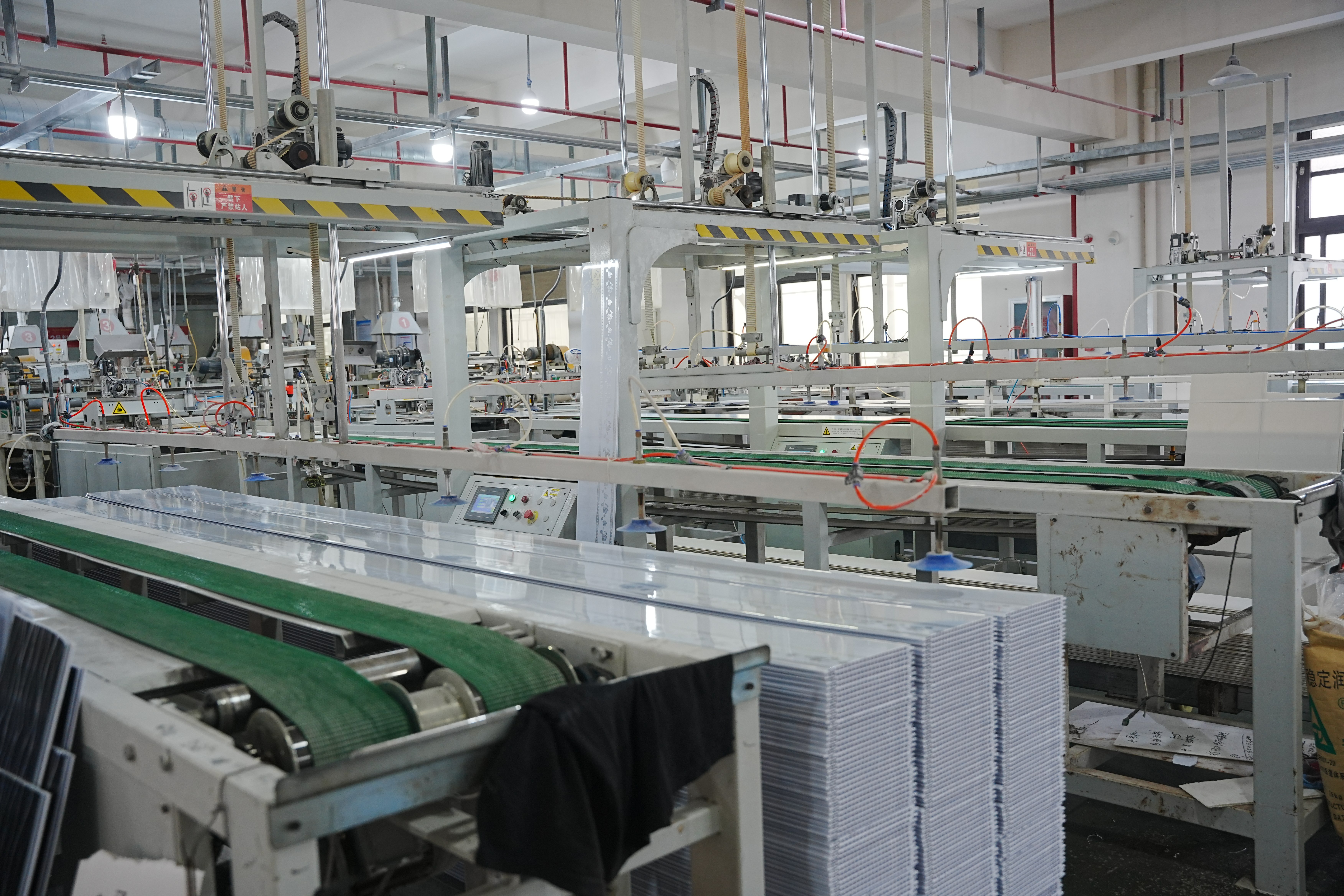
Hisea runs quality control across three stages: incoming raw materials are inspected batch by batch to keep formulation and process parameters consistent; in-process control points monitor thickness, density, color difference, surface flatness and texture consistency; and every batch is inspected before shipment, with loading arranged only after the batch passes inspection. Production runs as a continuous loop from raw material to finished product — formulation, extrusion or calendering, surface treatment, then cutting and packaging.
Step 7 — Agree MOQ, lead time and payment terms before the RFQ closes
Trial orders normally start from 300 pieces and can be mixed by colour and size. Delivery terms are FOB, DDP and CIF, with TT payment terms. Typical production lead time is 20–30 days, and a 40HQ container is usually quoted at 20–25 days after deposit.
Use Cases: Matching the Panel to the Room
The three families overlap less in practice than they do on a price list, because each one solves a different wall condition.
- Damp and hygiene-sensitive interiors — PVC wall panel. Where a wall currently carries tiles or a coating and the goal is a fast, cleanable covering, the 300 mm extruded profile installs over battens or a flat dry substrate with clips, screws or adhesive and needs no on-site painting.
- Feature walls, lobbies and hospitality interiors — WPC wall panel. Interior feature walls, TV backgrounds, living rooms and bedrooms, hotel lobbies and corridors, offices and meeting rooms, restaurants, retail stores and showrooms, and ceilings are the typical WPC applications. The ribbed profile format is what creates the visual rhythm in these spaces.
- Long uninterrupted interior walls — UV board. At 1220×2440 mm the sheet covers a wide area with few joints, and the gloss or matte face sets the reflective character of the finished wall.
- Indoor and outdoor combined projects — WPC wall panel. WPC panels are specified for both indoor and outdoor installation in humid environments at normal ambient temperature, so a project that runs from an interior corridor to a covered exterior wall can be specified in one family.
A recent custom order illustrates how mixed catalogues work in practice: a personalised-customisation order shipping to customers in the Philippines, Poland, Palestine and Portugal, comprising a single 40-foot high-cube container of panels for sale and for private use in decorating indoor and outdoor areas. Over a five-year relationship, the reported outcome was an excellent installation finish, correct dimensions, no colour difference, and continued repeat ordering. The value of that pattern for a buyer is straightforward — a supplier able to serve both resale stock and direct decoration projects from the same production line reduces the number of vendors a distributor has to manage.
Compliance and Documentation: What to Verify Before Ordering
Both the WPC and PVC ranges carry a Technical Inspection Attestation of Conformity issued by UDEM under EN 17104:2021, and both attestations run to 2031-08-09. That long validity window is useful for project planning, but it does not remove the buyer’s verification step.
The verification steps that commercial procurement guidance recommends are consistent and worth applying to any certificate, including these two:
- Check that the certificate names the exact product, thickness, construction and surface finish being ordered.
- Check that the report cites the current edition of the standard rather than a superseded one.
- Check that the issuing laboratory’s accreditation scope actually covers the relevant test method.
- Check the expiry date and the issuing body against the document in hand, not against a marketing page.
Fire-performance frameworks differ by jurisdiction — EN 13501-1 is referenced for Europe and the UK, ASTM E84 for the USA and Canada, and GB 8624 for China — and commercial guidance stresses that these systems use different test methods and classifications and should not be treated as equivalent without a formal basis. Where a project has a fire-classification requirement, the applicable framework, the exact panel construction and the accredited test report should all be confirmed for the project’s destination market.
FAQ
1. Do the WPC and PVC wall panel ranges hold an EN 17104:2021 CE attestation?
Yes — both ranges are covered by Technical Inspection Attestations of Conformity issued by UDEM under EN 17104:2021. The WPC Panel attestation is certificate number M.2026.06.C1.45891, issued 2026-08-07 and valid until 2031-08-09, covering WPC profile formats including 160×24 mm, 160×22 mm, 160×20 mm, 150×10 mm, 150×15 mm, 140×18 mm, 140×13 mm, 150×13 mm, 194×10 mm, 180×20 mm, 200×11 mm and 200×20 mm, plus 50 mm accessories and 1220×3000 mm formats. The PVC Panel attestation is certificate number M.2026.206.C145889, issued 2026-08-10 and valid until 2031-08-09, covering PVC Panel models including 300×8×2900 mm, 300×9.5×2900 mm, 300×10×2900 mm, 300×600 mm, 595×595 mm, 600×600 mm, 603×603 mm and 1220×3000 mm formats. Because each attestation lists specific models, buyers should match the certificate scope against the exact dimension on the purchase order. The UV board range is not covered by these two documents.
2. Can the manufacturer produce custom sizes, colours, patterns and packaging?
Yes. OEM production services are available for custom production orders and cover customised patterns, customised packaging, customised colours and customised sizes. In practice this means custom pattern development, custom colour matching, custom packaging and custom size customisation for OEM orders, produced in-house and served into South America, Southeast Asia and Africa among other export markets. Buyers who need a private-label programme or a distributor-specific carton design should confirm the artwork and packaging format at the sampling stage rather than after the production order is released.
3. What are the MOQ and commercial terms for a trial order?
Trial orders normally start from 300 pieces and can be mixed by colour and size, which lets a distributor test several finishes or dimensions in a single shipment instead of committing to one pattern. Delivery terms available are FOB, DDP and CIF, and payment terms are TT. Because MOQ is expressed in pieces rather than square metres, buyers mixing narrow WPC profiles with 300 mm PVC panels should confirm the piece count per format early, since the covered area per piece differs substantially between a 150×15 mm profile and a 300×8 mm profile.
4. How can batch quality and dimensional consistency be validated before full-scale ordering?
Validation rests on the production control loop rather than on a single sample. Raw materials are inspected batch by batch to keep formulation and process parameters consistent. In-process control points monitor thickness, density, colour difference, surface flatness and texture consistency at the key stages. Every batch is inspected before shipment, and loading is arranged only after the batch passes inspection. A custom order shipped as a single 40-foot high-cube container to customers in the Philippines, Poland, Palestine and Portugal, used for both resale and private indoor and outdoor decoration, reported correct dimensions, no colour difference and an excellent installation finish, and the customer continued ordering over a five-year relationship. For a distributor, that sequence — incoming control, in-process control, pre-shipment inspection — is what should be requested as documented evidence at each stage.
5. What lead time should be planned for a container order?
Typical production lead time is 20–30 days, and a 40HQ container is usually produced in 20–25 days after deposit. Monthly output reaches 20 × 40ft high-cube containers, which supports container-level and multi-container procurement while keeping delivery expectations relatively stable for large orders. If you are planning a multi-container programme across WPC and PVC ranges — or need to confirm whether a specific dimension such as 300×8.5 mm or 195×12 mm falls inside the current attestation scope — the fastest route is to send the project wall list and destination market directly to the supplier so both the specification and the documentation check can be answered together. You can request a sample or a quotation through the contact details at the end of this page.
Conclusion: A Simple Rule for 2026 Interior Projects
The three families are not competing versions of one product. They are three answers to three different wall conditions.
- If the wall is damp, hygiene-sensitive or a tile replacement, start with a PVC wall panel at 300×8 mm or 300×8.5 mm.
- If the wall needs a ribbed architectural rhythm, or runs from interior to a humid or covered exterior condition, start with a WPC wall panel at 160×22 mm, 160×24 mm, 150×10 mm, 150×15 mm or 195×12 mm.
- If the wall is long and uninterrupted and the goal is minimal joints, start with a UV board at 1220×2440×3 mm or 1220×2440×2.5 mm in gloss or matte.
Then apply the two checks that prevent most re-quotes: confirm the certificate lists the exact dimension you are buying, and confirm the surface finish from a physical sample. Both WPC and PVC ranges covered by Zhejiang Highsea New Material Co., Ltd. hold EN 17104:2021 attestations valid to 2031-08-09, which carries a project comfortably past a typical specification cycle — provided the dimension on the purchase order matches the dimension inside the certificate.
Next Step: Specification Sheet, Sample or Quote
Send your wall list — room type, moisture condition, approximate area and destination market — and you will get back a recommended panel family, the matching dimensions, and the certificate scope that covers them.
Contact: Tommy · Tel / WhatsApp: +86 135-8645-8141 · Email: Tommy@zjhisea.com · WhatsApp: start a chat
Website:www.zjhisea.com | Blog:blog.zjhisea.com
Download the product catalogue (PDF):Hisea Decorative Wall Panel Catalogue
Zhejiang Highsea New Material Co., Ltd. (Hisea-Decorative Film & Decorative Panels) · Room 2101, 2# Building Heli Plaza, No.365 Qianjiang Road, Haining City, Zhejiang Province, China 314400 · Founded 2002 · 20,000 m² factory · Monthly output 20 × 40ft high-cube containers · Export share 70%
Suggested On-Page SEO Fields
Primary query: WPC vs PVC vs UV board wall panels comparison
Search intent: Commercial investigation (specification and supplier selection)
Suggested slug: /wpc-vs-pvc-vs-uv-board-wall-panels-2026-comparison
Page role: Cluster / supporting comparison page under the Wall Panel pillar
Supporting queries: PVC wall panel sizes, WPC wall panel standard sizes, UV board 1220×2440 thickness, waterproof wall panel for interior projects, EN 17104:2021 wall panel CE certificate, quick installation wall panel for damp areas
Have Questions or Need More Details?
Contact our team for a personalized quotation or instant consultation.
Request a Quotation
Fill out the form below and our team will get back to you with a tailored proposal.
WhatsApp Direct Chat
Prefer to chat in real-time? Message us on WhatsApp for instant assistance & quick answers.
- Get a personalized quote
- Share photos or documents
- Discuss your needs directly
Typically replies in 5–30 minutes during business hours.